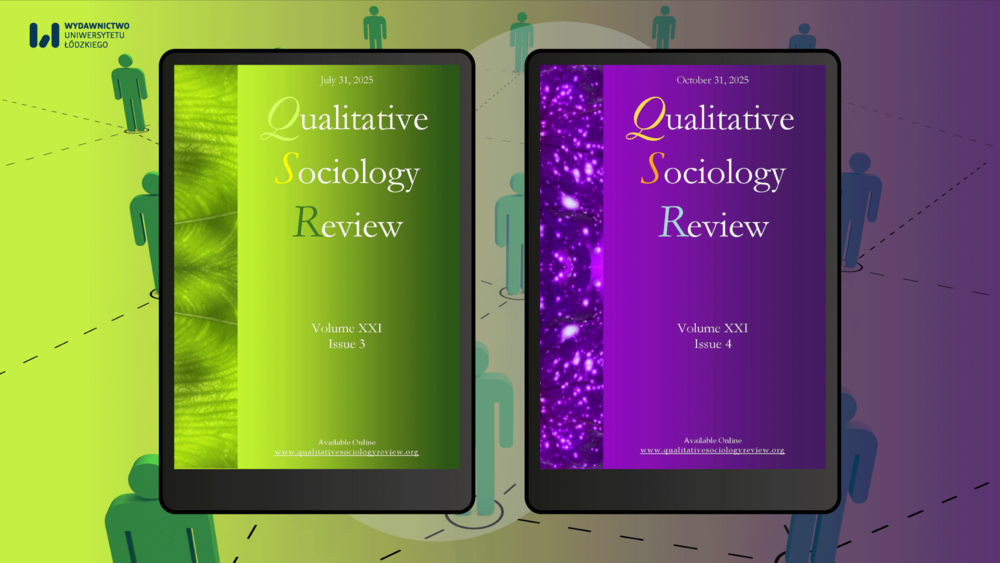
The latest volumes of Qualitative Sociology Review bring together diverse explorations of contemporary social life, offering empirical, methodological, and theoretical insights into how individuals and communities navigate intimate practices, educational spaces, technological encounters, family stressors, urban sociability, and professional challenges.
The following articles are included in Vol. 21, No. 3 (2025):
The Sociality and Liminality of Bangkok’s Cannabis Cafés
Jack Fong
In June 2022, Thailand became the first country in Asia to decriminalize cannabis, only to face opposition from conservative political forces that are now attempting to pass policies that will recriminalize its recreational use. My qualitative study conducted between summer 2022 and the conclusion of 2024 examines the sociality of 45 cannabis cafés in the capital Bangkok despite these developments, enhanced by my status as having grown up in the city and speaking the Thai language and local Chinese dialects. Employing urban sociological concepts such as Ray Oldenburg’s third places and Lyn Lofland’s notion of the urban experience as characterized by interactions with strangers, I describe Bangkok’s cannabis cafés as third places that reduce the status of the stranger, and thus destress the actor in its lifeworld. These dynamics are argued to counter Bangkok’s over-stimuli and stressor-filled experiences, now challenged by policy developments that place the continuing operations of cannabis cafés in a liminal state.
Labor of Care and Contracts: A Study of Surrogacy after the Transnational Ban in India
Ruby Bhardwaj
Characterized by the interplay of care and contracts, surrogacy is an exclusive form of gendered work. The paper is based on a micro-level ethnographic study exploring the lived and embodied challenges of commercial gestational surrogates in Gujarat, India, who were undertaking surrogacy work after the ban on transnational surrogacy. The experiential accounts collected through in-depth, face-to-face interviews bear the challenges, stigma, and shame involved in surrogacy work. Not only is surrogacy work devalued, deprived of dignity, and shrouded in secrecy, but it is also corrupted by contracts, complicated by alienation and relinquishment of the gestated child. Surrogates disguise their work and stay in surrogacy hostels. Poverty in India compels many women to engage in surrogacy to eke out a living and improve their living conditions. Surrogate mothers are poorly paid, deprived of health benefits and legal security, they receive only twenty percent of the total cost of the surrogacy arrangement, and are also treated as fungible and disposable. The paper adopts the ethics of care perspective to analyze surrogacy arrangements. Such a perspective is directed toward promoting a responsible and humane attitude toward commercial surrogates. It is motivated by the need to uphold the dignity of the surrogates, their legal rights, and the social recognition of their work. The application of care ethics can alleviate the neglect and oppression of surrogates.
Ethical Processes and Dilemmas during Research with Youth on Cyber-Risk
Jay Cavanagh, Michael Adorjan, Rosemary Ricciardelli
In this article, we reflect on the ethical processes and dilemmas we encountered in almost a decade of qualitative research with teenagers about digital technologies and cyber-risk. Our research underscores both the opportunities and challenges of teenagers’ engagements with digital technologies, including cyberbullying and image-based sexual harassment and abuse (i.e., non-consensual sexting), on popular social media platforms. Our current research explores teenagers’ experiences with cyber-risk during the COVID-19 pandemic, including managing homeschooling (due to lockdowns), online addiction, mental health challenges, and encounters with disinformation and misinformation. We discuss our experiences with focus group facilitation and one-to-one semi-structured interviews, specifically our reflections on ethical processes encountered in the field, such as fostering rapport with young participants given the significant age gaps and our lack of knowledge at times, regarding digital technologies or topics like image-based sexual abuse. We also discuss our experiences conducting research with teenagers under the new capacity to consent ethical framework, which positions children and youth as often having agency to consent to research independently from their parents or legal guardians. Here, we detail reflections on navigating a new approach and highlight some of the considerations arising from ascertaining assent and consent. Centralizing issues of developing rapport, trust, and ethical processes related to interactional dynamics during interviews, the paper provides insights and possible strategies for those conducting research with children and youth.
Recording Solo: Managing Long-Distance Data Collection within Audio Diary Research with Healthcare Professionals
Veronica Moretti
This paper explores the methodological and reflexive implications of using audio diaries in remote qualitative research with healthcare professionals. Drawing on a three-month study involving 18 participants who submitted audio recordings weekly, complemented by follow-up interviews, the article examines how this method enables the collection of rich, emotionally nuanced, and temporally proximate narratives. The audio diary format proved particularly effective for engaging professionals under high emotional and organizational pressure, offering a flexible and participant-led space for reflection. The study also sheds light on the challenges of sustaining participation over time, the importance of ethical responsiveness, and the role of the researcher in supporting engagement at a distance. Ultimately, the paper proposes the concept of long-distance reflexivity to describe how both participants and researchers negotiate meaning, presence, and vulnerability in fully remote research settings.
Vol. 21, No. 4 (2025) features the following articles:
Selling Sleep: A Qualitative Study of Infant Sleep Coaching in Western Canada
Cressida J. Heyes, Jeanique Tucker
This article theorizes the experience of using a coach to assist with a baby or young child’s sleep “training” as occurring at the intersection of three broader phenomena: the increasing use of paid experts to advise on intimate life; the porosity of the domestic sphere; and ideologies of mothering that impact sleep. It draws on the vernacular of a growing critical literature on children’s sleep, which understands its practice and representation as symptomatic of culturally and historically specific demands on the organization of space and time, as well as understandings of the child as a site of future potential and human capital. To do so, it draws on a qualitative study of sleep coaches and the mothers who hire them. The authors conducted semi-structured, open-ended interviews with thirty women in Western Canada. The interview data revealed that the sleep deprivation entailed in having a new baby is both a dramatic (and often under-estimated) feature of human facticity and a socially mediated crisis. Paradoxically, the overabundance of expert advice on children’s sleep made mothers more likely to recruit a coach for customized support. The advice coaches provided, and how mothers interpreted it, balanced the pragmatic and the ideological, among other things, revealing poorly evidenced but pervasive anxieties about attachment, independence, mental health, and future well-being.
Is There a Sociologist in the Room? Raising the Sociological Voice in Educational Spaces
Sari R. Alfi-Nissan
Educational spaces are both material and human sites. While people design and build the physical space of educational institutions, these spaces also shape human behavior, interaction, and thought, playing a crucial role in the articulation of discourse. Critical Discourse Analysis (CDA) in educational research tends to rely primarily on document and text analysis, often overlooking the spatial dimensions of discourse and how social actors interpret the spaces they inhabit. This article presents the use of semiotic codes analysis of educational spaces as a methodological tool for studying discourse in institutions where ethnographic access is limited. Drawing on a qualitative study conducted in twelve Israeli state schools, this article examines how global discourses of entrepreneurialism and aspiration, which promote an ideal of a future-oriented and self-managing individual, are expressed and interpreted in everyday school settings. Through observations, walking interviews, and semiotic analysis, the study demonstrates how spatial articulations, wall texts, and visual displays work together with educators’ interpretations to shape and sometimes contest dominant ideals. The analysis merges critical spatial semiotics with a pragmatic approach to everyday meaning-making, offering a methodologically innovative and reflexive approach to discourse analysis in education.
The Experience of Everyday Life Alongside Virtual Companions. A Case Study of Human-Chatbot Encounters
This article a nalyses i nteractions between a human and a virtual entity, namely, a chatbot. These encounters are considered in the context of cyberspace, understood as a specific social interactional space. They are also examined in the context of an individual’s experiences, which are intertwined with ongoing social and cultural changes. This text engages with research on chatbots, complementing their findings with an in-depth study of the user perspective. The analysis is based on data from an in-depth interview with Laura, conducted as part of a research project on human interactions and relationships with chatbots. The case study of Laura’s experiences explores her perception of interacting with a chatbot, focusing on the meanings humans assign to such interactions, concerning the interviewee’s emic perspective. The article examines how a human interlocutor perceives chatbots and the role they can play in an individual’s life. In addition, the reflection in the text touches on the theme of humans seeing themselves in the responses of a chatbot, which lacks self-awareness and cannot understand the content it produces in the same way a human can. The article deepens understanding of chatbots as everyday companions, virtual friends, and social actors, encounters with whom are part of today’s reality.
COVID-19 as a Family Stressor: A Life Course Exploration of Family Stress Among Rural Grandparents and Their Adult Children in Upstate New York
Laura Obernesser
COVID-19 has brought about many changes for rural families, affecting their family roles, childcare responsibilities, financial status, and experiences of family stress. In this study, I examine (1) how rural grandparents and their adult children perceive family stress related to their family roles and responsibilities during COVID-19 and (2) how rural grandparents and their adult children have coped with the stress of family roles and responsibilities during COVID-19. Data comes from 44 in-depth interviews. The findings of this study suggest that COVID-19, a family stressor, has been the source of stress among rural grandparents and their adult children. The findings suggest that families adapted through a range of improvised strategies such as relocating, abstaining from employment, taking on additional childcare, and adjusting personal identities to maintain stability during uncertainty. These adaptations were not merely practical but often guided by moral and faith-based reasoning, allowing participants to maintain agency despite constraints.
Before the COVID-19 pandemic, grandparents played a significant role in childcare, sometimes to the point of being the primary childcare providers (Harrington Meyer 2014). COVID-19 has further complicated the roles and responsibilities of rural grandparents and their adult children. COVID-19 brought changes to rural families, particularly in the areas of their employment, family roles and relationships, childcare responsibilities, and sense of hope.
Together, Vol. 21, No. 3 and Vol. 21, No. 4 of Qualitative Sociology Review provide a rich panorama of contemporary qualitative sociology – from intimate family practices and educational spaces, through digital risks and virtual companions, to urban sociability, surrogacy, and innovative methodologies.


