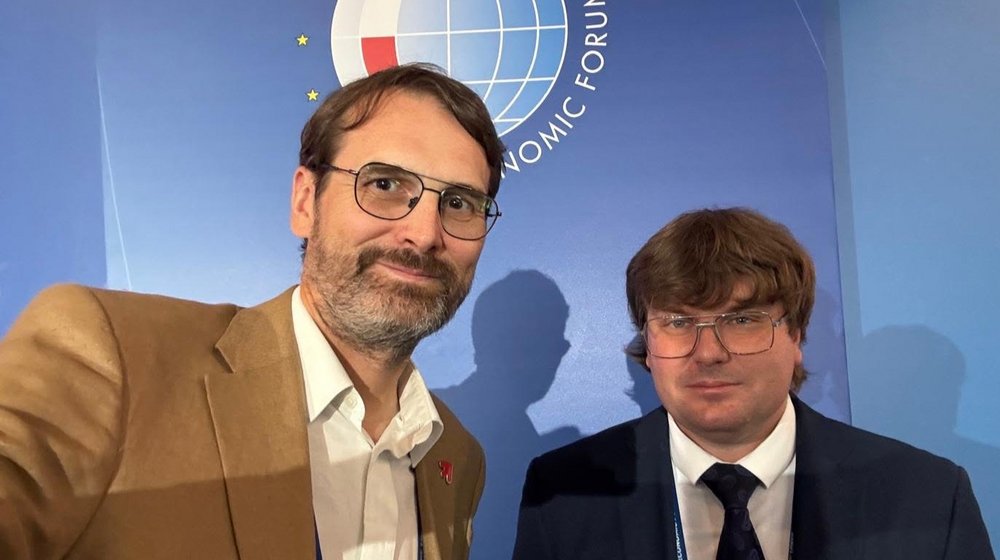
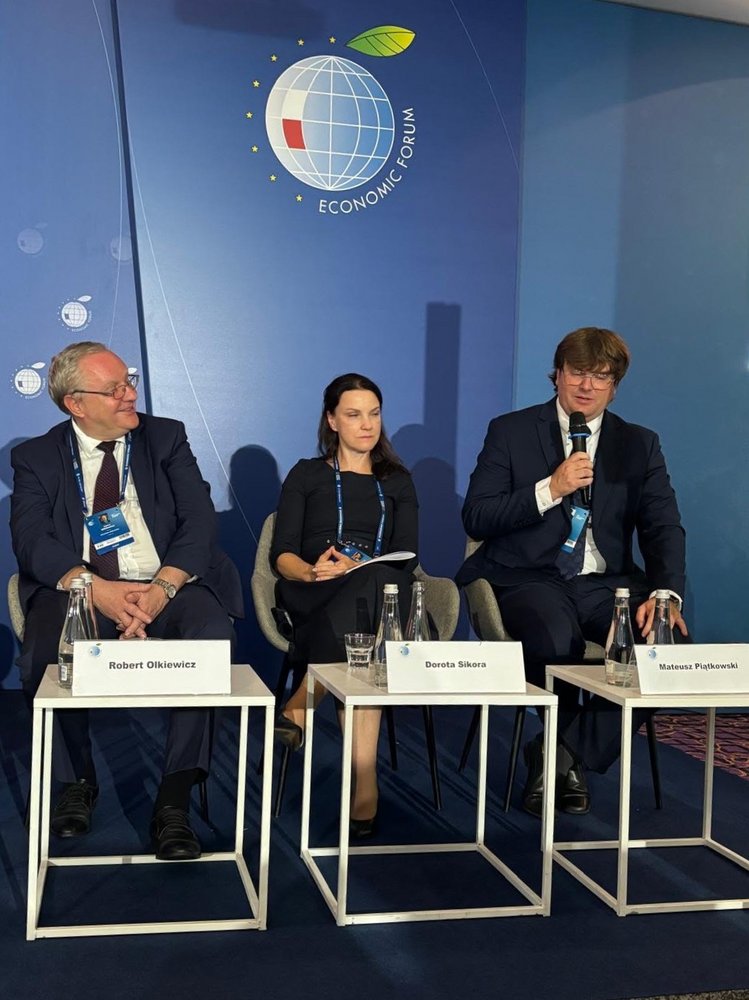
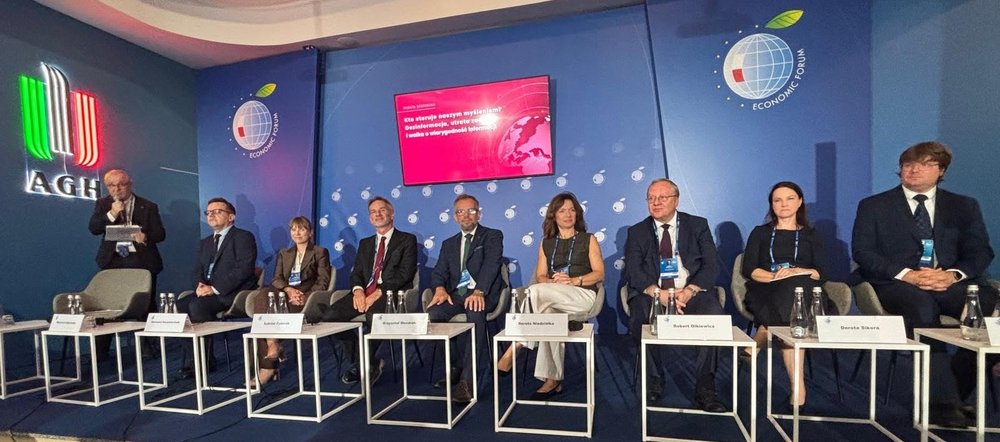
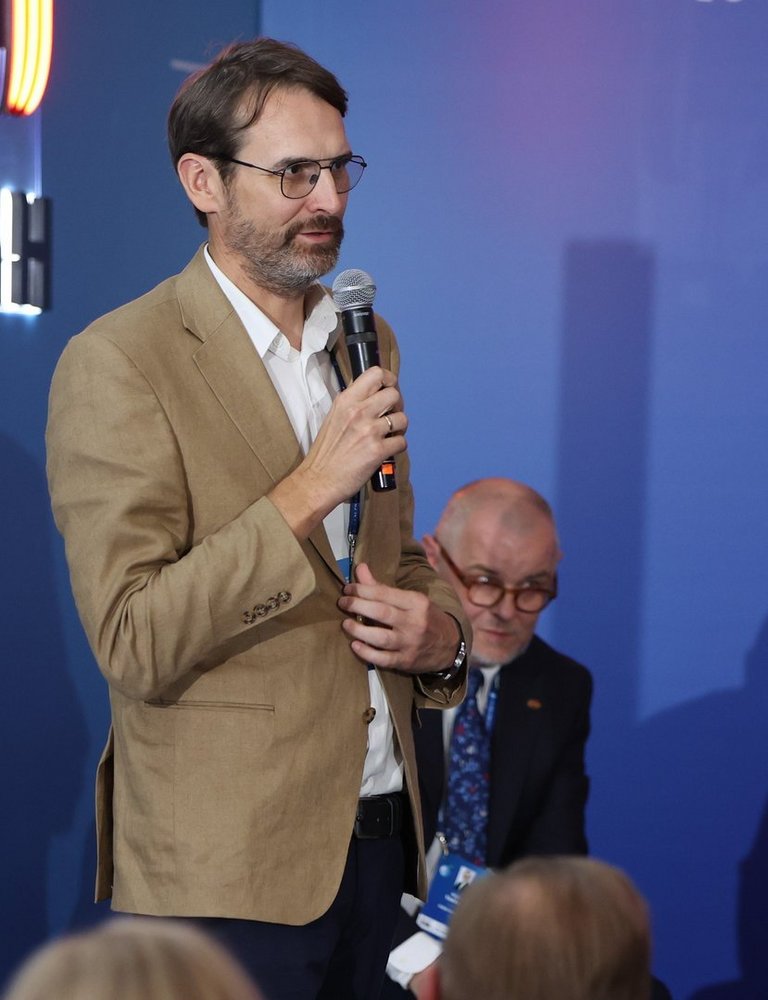
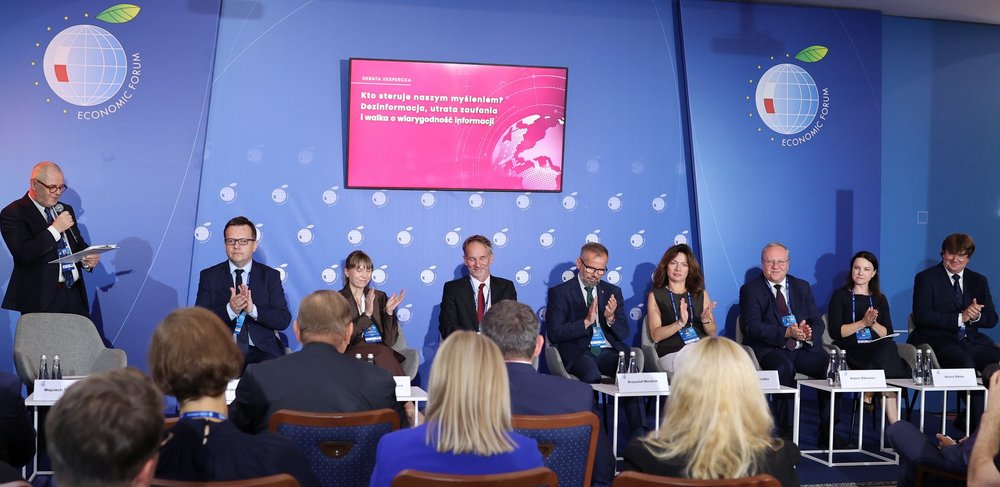
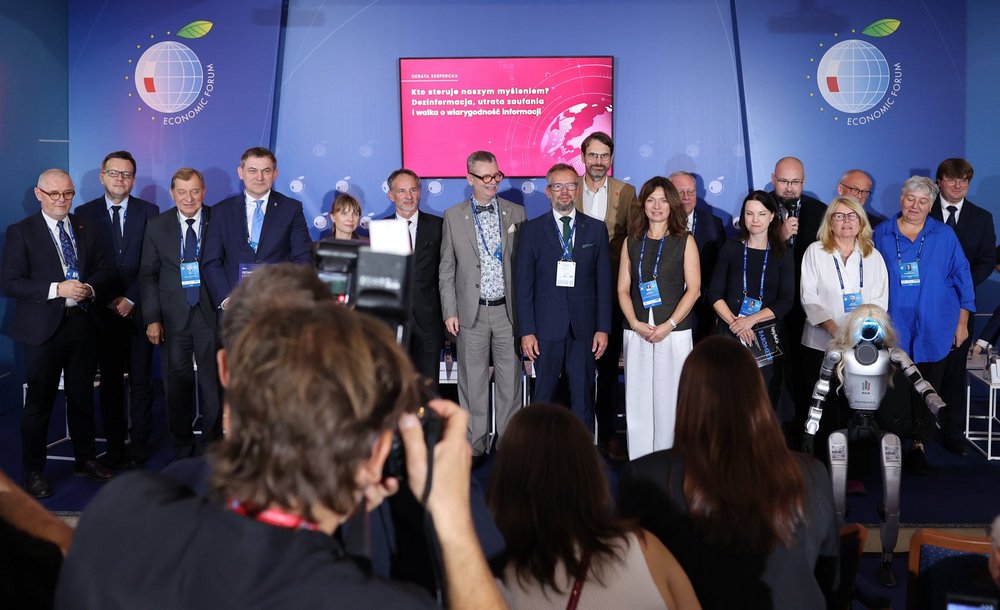
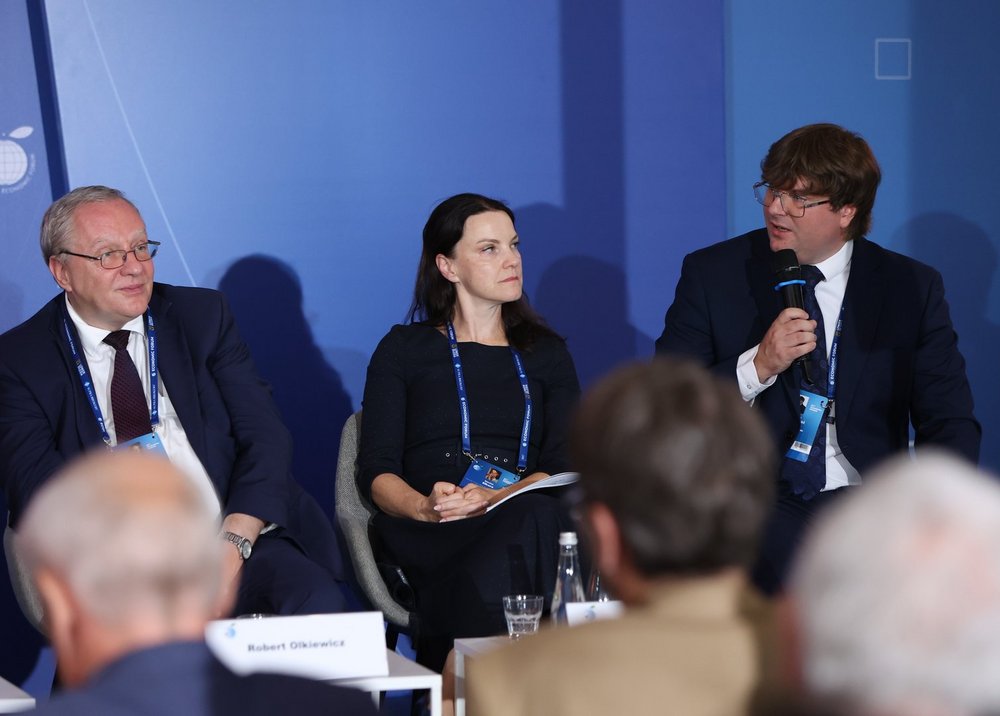
As every year, the conference has brought together thousands of leaders and experts from the fields of politics, business, science and culture, who are spending three days discussing the future of Europe and the world, including economic challenges, security and technology. Yesterday, on the second day of the Forum, the Rector of the University of Lodz, Prof. Rafał Matera and Dr Mateusz Piątkowski from the Department of Public International Law and International Relations, Faculty of Law and Administration, University of Lodz, took part in a debate entitled “Kto steruje naszym myśleniem? Dezinformacja, utrata zaufania i walka o wiarygodność informacji” [Who Controls Our Thinking? Disinformation, the Loss of Trust and the Struggle for Information Credibility].
The starting point for the discussion was the presentation of a report by experts from the Jagiellonian University, prepared in cooperation with the Polish Press Agency, entitled “Dezinformacja i bezpieczeństwo. Definicje, mechanizmy, rekomendacje” [Disinformation and Security: Definitions, Mechanisms, Recommendations]. Its authors analysed the phenomenon of disinformation and issues related to cognitive security from the perspectives of psychology, media studies and political science. They examined, among other things, mechanisms of susceptibility to manipulation, the impact of emotions and group identity, the role of media, digital platforms and influencers, cognitive warfare, and FIMI operations. The report also contains recommendations concerning cooperation between the state, academia, the media and civil society.
One of the concepts proposed by the authors is “certinformacja”, defined as truthful information disseminated without the intention to manipulate, in good faith and in accordance with verification standards applicable in science or journalism. The authors argue that the response to disinformation should not be limited solely to correcting individual falsehoods. It should also involve building an information environment saturated with reliable and verified content, highlighting the crucial role that science and universities can play in this process.
The report presentation was followed by a discussion among experts representing the AGH University of Krakow, the John Paul II Catholic University of Lublin, the SGH Warsaw School of Economics, Adam Mickiewicz University in Poznań, the Jagiellonian University, the University of Lodz, the Wroclaw Medical University, and the University of Wroclaw. The University of Lodz was represented by Dr Mateusz Piątkowski from the Faculty of Law and Administration, University of Lodz, a specialist in international and military law who frequently appears in the media. The discussion focused on, among other issues, the loss of trust in information sources, media responsibility, the role of algorithms and digital platforms, the impact of AI, the security of science and the credibility of research, as well as disinformation activities.
The debate concluded with remarks from the rectors of the eight higher education institutions cooperating with the Polish Press Agency, including the Rector of the University of Lodz, Prof. Rafał Matera, who reflected on the specific actions Polish universities should take to strengthen the cognitive security of society.
I believe that the most important task for Polish universities today is to generate trustworthy knowledge and effectively bring it into the public sphere. Conducting research alone is not enough. We must also help people understand a world in which artificial intelligence, algorithms and disinformation play an increasingly significant role.
The University of Lodz has been pursuing this mission for years. We teach critical thinking, verify information, question assumptions and encourage informed debate. For the past decade, we have been systematically developing our Expert Database, which now includes around 130 researchers ready to share their specialist knowledge across a wide range of fields. Dr Mateusz Piątkowski has been one of its members for many years and has frequently provided expert commentary on current affairs. This is a tangible contribution and our way of supporting reliable media. Only by working together can we effectively counter disinformation.
At the University of Lodz, we also conduct research on artificial intelligence, cybersecurity and cyber law, among others through the Centre for Artificial Intelligence and Cybercommunication Research and the Lodz Cyber Hub. Our researchers prepare expert analyses for national and European institutions, study the mechanisms of disinformation and support the development of digital competences. We are also co-developing PLLuM, a Polish large language model designed to serve public administration and citizens. At the same time, we educate people to critically assess information, use technology responsibly and recognise manipulation.
I feel convinced that this combination of research, education and the responsible dissemination of knowledge constitutes the most important contribution universities can make to society’s cognitive security. This is why we are strongly committed to supporting the Polish Press Agency Think Tank initiative
– said Prof. dr hab. Rafał Matera, Rector of the University of Lodz, in his closing remarks following the debate.
The full photo gallery from the debate
Source: Polish Press Agency (PAP); Press Office, University of Lodz
Edid and photos: Live Foto PAP, University of Lodz


