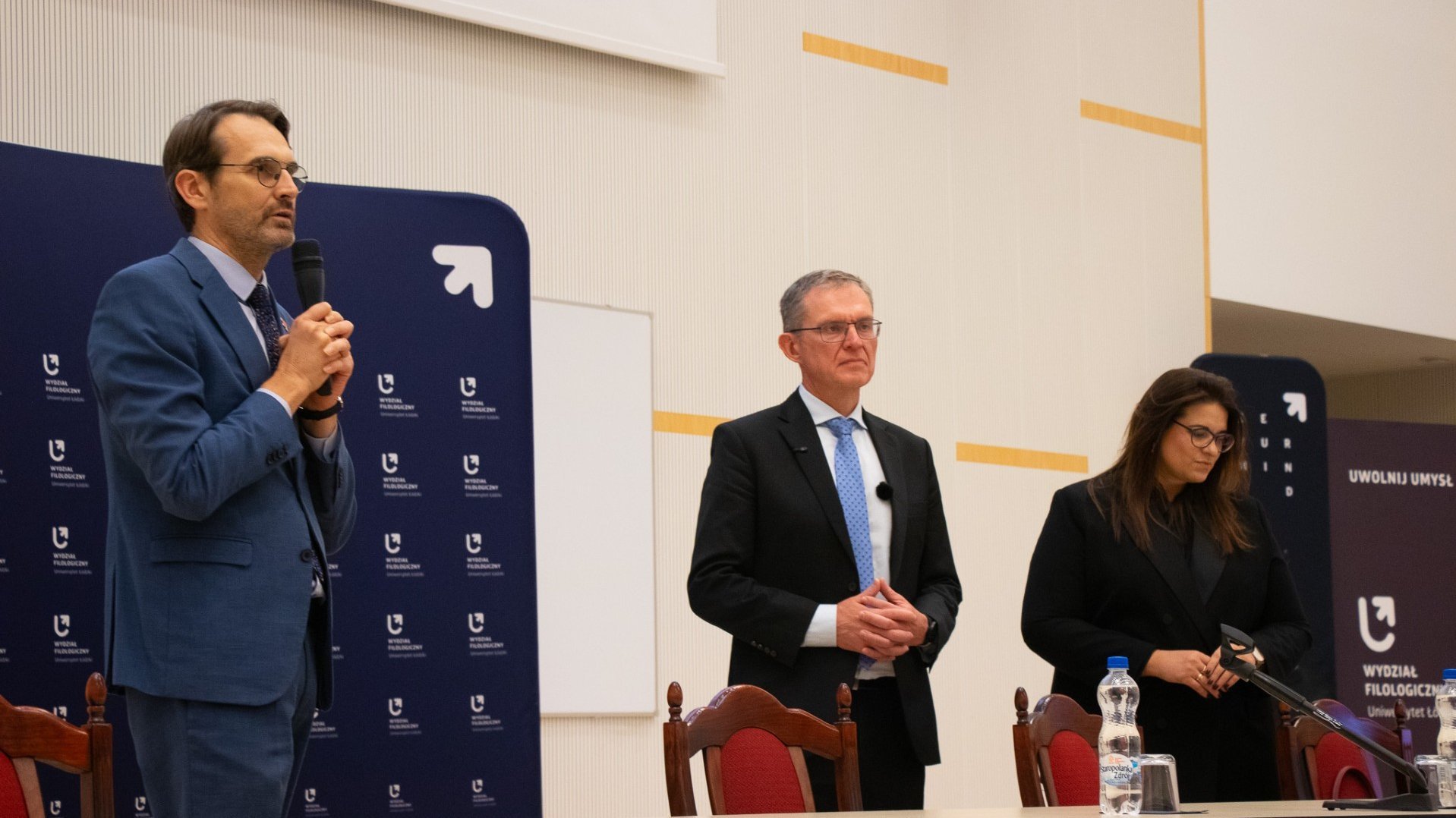
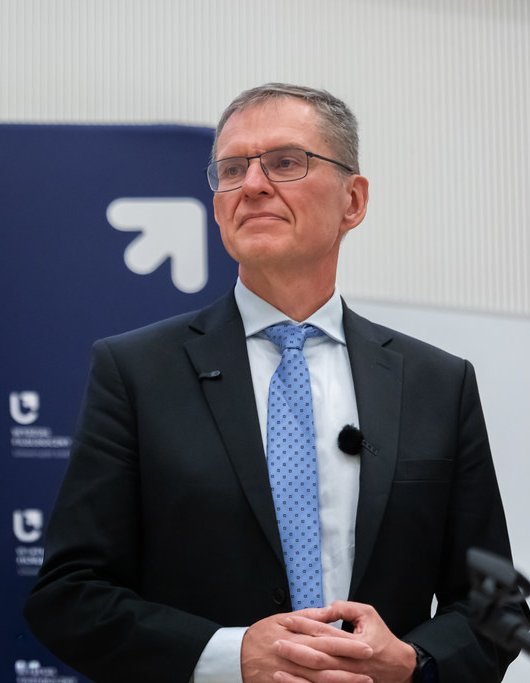
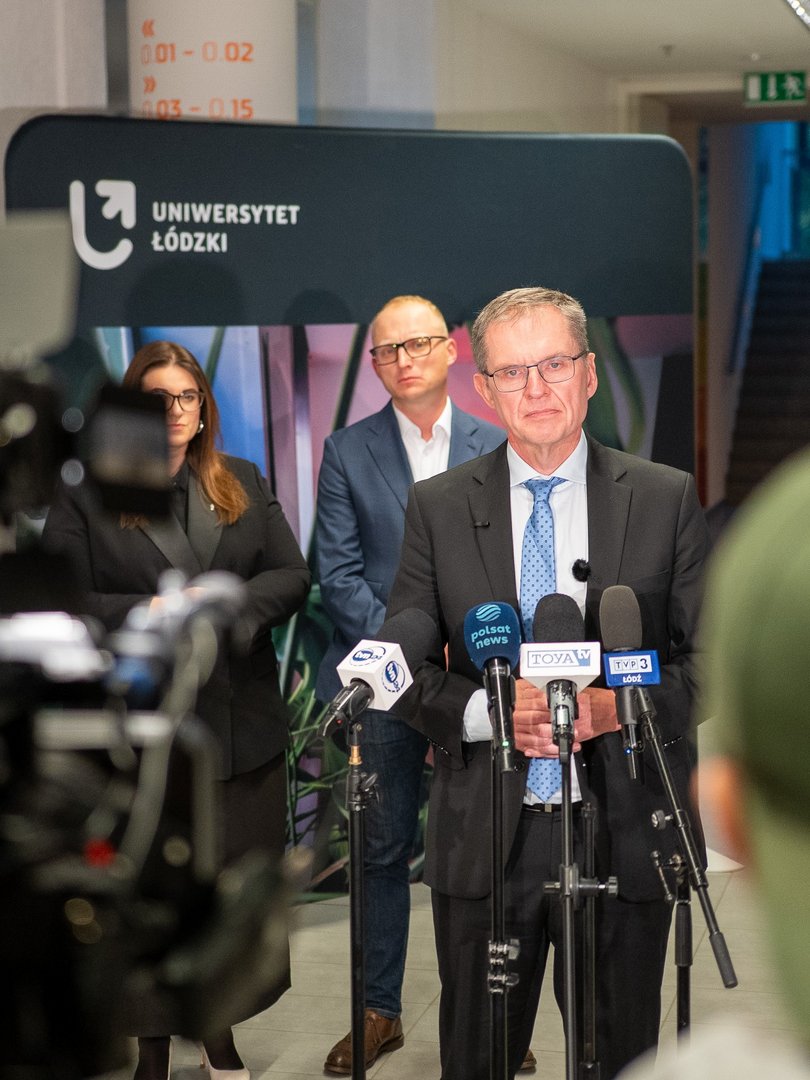
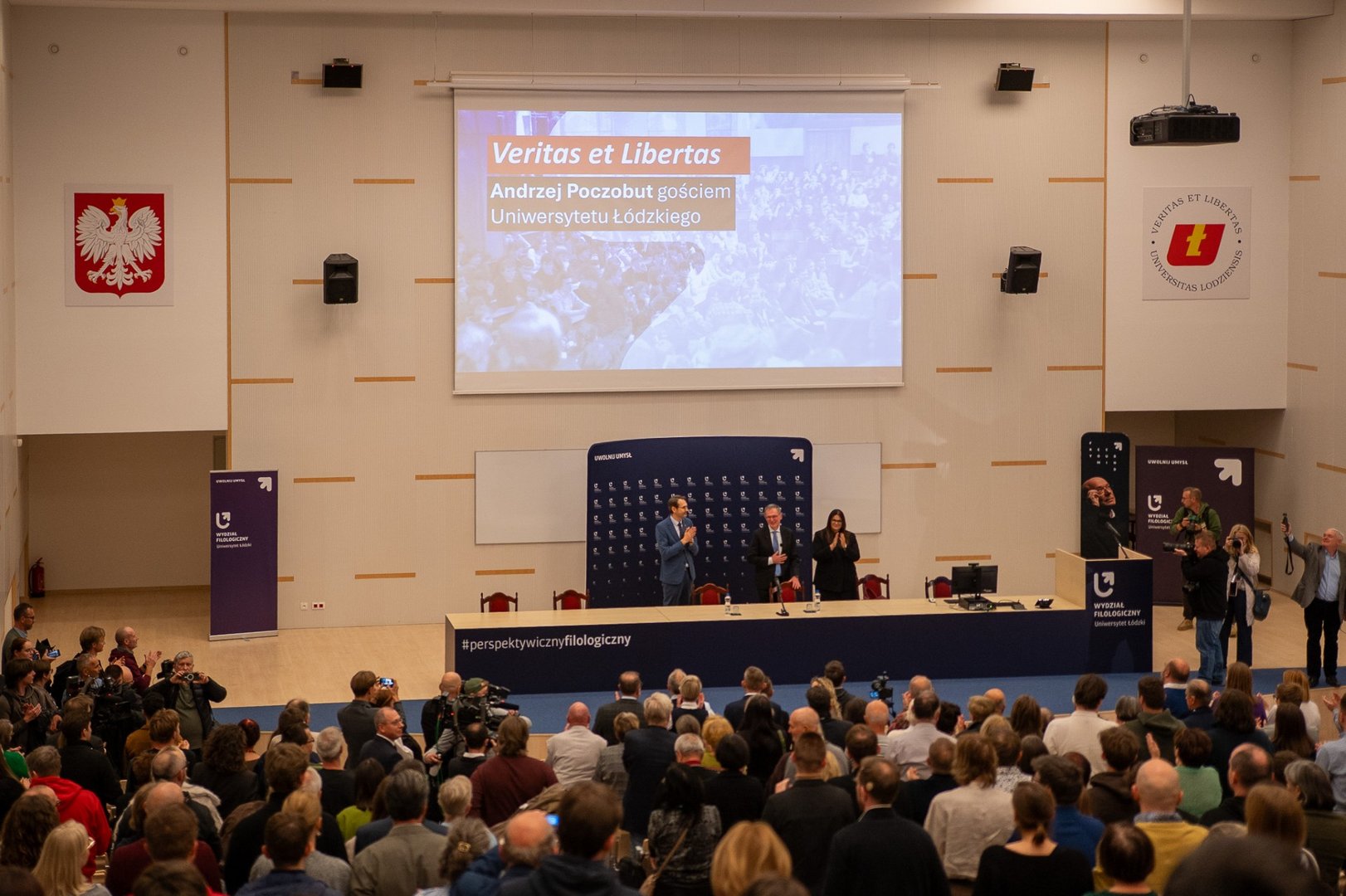
Today, within the walls of our university, we are meeting a man who, through his attitude and activities, best embodies the motto of the University of Lodz: Veritas et Libertas (Truth and Freedom). We therefore extend an especially warm welcome to Andrzej Poczobut to our university
– said the Rector of the University of Lodz, Prof. dr hab. Rafał Matera, opening the meeting.
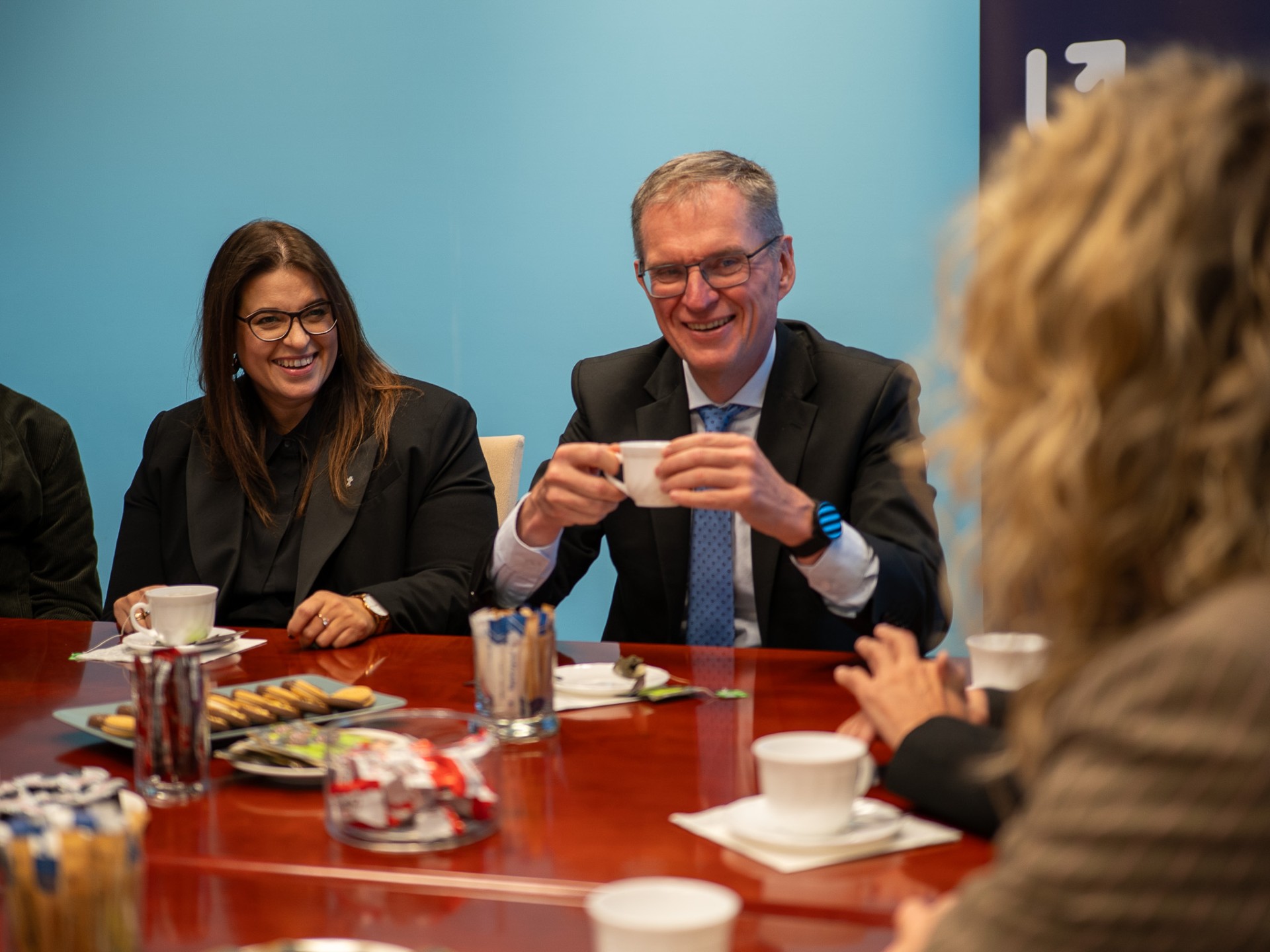
The guest was accompanied by representatives of the Foundation “Pomoc Polakom na Wschodzie” and Dr Barbara Jundo-Kaliszewska from the Faculty of International and Political Studies of the University of Lodz, who initiated the invitation of Andrzej Poczobut to the University of Lodz.
History as the sum of the experiences of states and nations, freedom and truth were the key areas and concepts that Andrzej Poczobut subjected to multi-layered reflection during his lecture. These reflections were all the more valuable because they were grounded in his journalistic experience, his thorough knowledge of history and contemporary social realities in post-Soviet countries, as well as his own dramatic experiences of political repression suffered at the hands of the Belarusian regime: accusation, trial, imprisonment and a five-year sentence in a penal colony.
While characterising the Soviet man living in the territories of the former Soviet Union, Poczobut stated that this was not a matter of nationality but rather a model of survival that is capable of reproducing itself very effectively. As a result, people in Russia and Belarus who were born after the collapse of the Soviet Union still long for that system.
In his analysis, Poczobut also demonstrated how authoritarian regimes subordinate the media, public debate, historical memory, the very concept of truth, as well as the legal system itself to their interests. He explained how, in authoritarian states, facts are displaced by narratives that are politically useful to those in power, and how the law, instead of protecting citizens, becomes a tool of repression against those who challenge such narratives.
Using contemporary Belarus as an example, Andrzej Poczobut presented post-truth as a method of governance: the state seeks to establish its own version of reality, determining which interpretations of facts and history are acceptable and which may be deemed hostile, extremist or anti-state. Particular importance is attached to the memory of the Second World War, which is simplified and subordinated to the current political needs of those in power, following a model used in Putin’s Russia: the cult of victory in the Great Patriotic War, the idealisation of the achievements of the Soviet Union, and the discrediting and marginalisation of the crimes of the communist system.
He recalled that the order to replace history textbooks was one of Lukashenko’s first decisions after assuming power.
History is not only about the past, but also about the sum of a nation’s experiences. People locate themselves within that chain of events and for that reason it is important for their future
– he said.
Andrzej Poczobut also referred to the concept of the so-called Western Russism prevalent in Belarus. According to this nineteenth-century ideology, Belarusians do not constitute a separate nation but are one of the three branches of a single great nation. The other two are Ukrainians and Russians. In such a context, any voice in Poland advocating an independent Belarus is viewed by the regime as an attempt to cut off one of these branches.
All of this means that, today, Belarus is geographically located in Europe, but, as Poczobut observed, in terms of mentality Asia begins on the Bug River, at the Polish-Belarusian border.
Truth and freedom are values of particular significance to the academic community of the University of Lodz. We are honoured to have welcomed Andrzej Poczobut to the University of Lodz. His courage, steadfastness and consistency in defending the truth are an extraordinary testimony to values that we also uphold.
This is also the responsibility of a university: not to oversimplify. To teach critical thinking, verification, (...) and the confrontation of different perspectives. To create a space for discussion, but discussion grounded in facts and responsibility for one’s words.
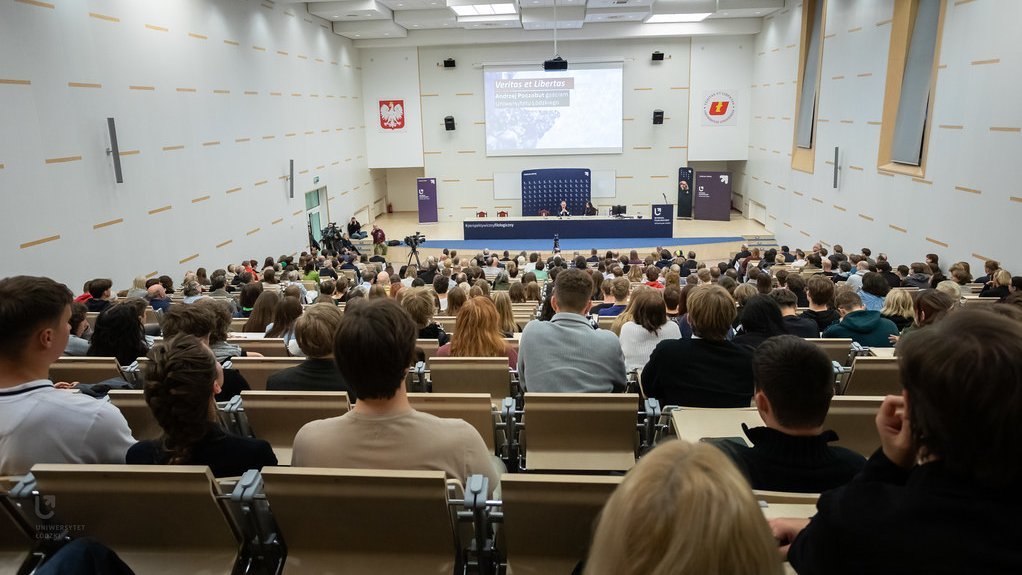
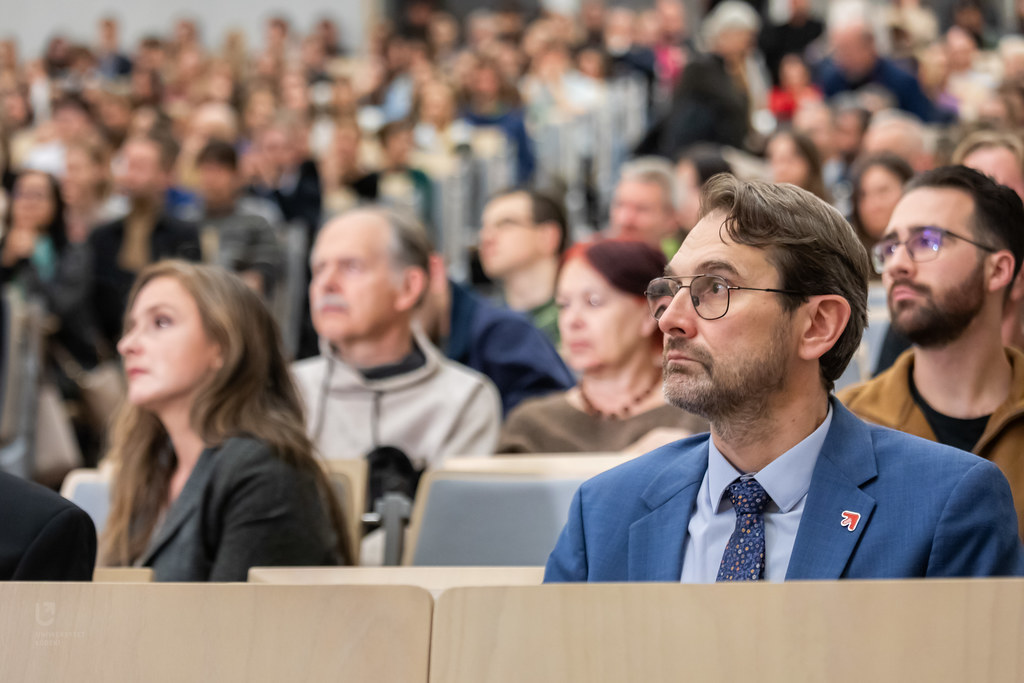
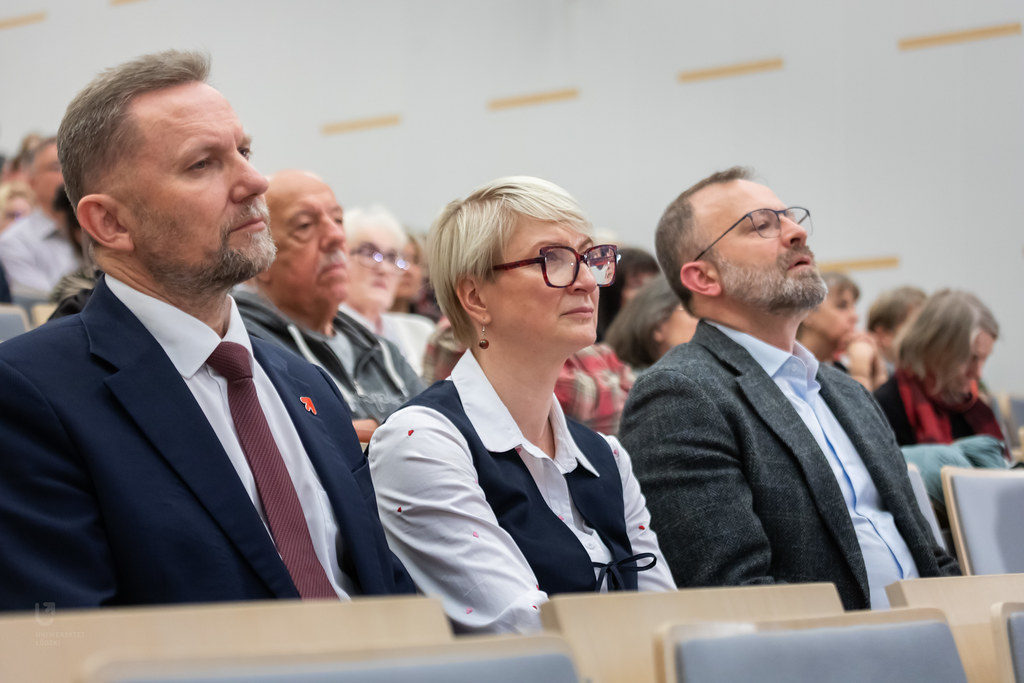
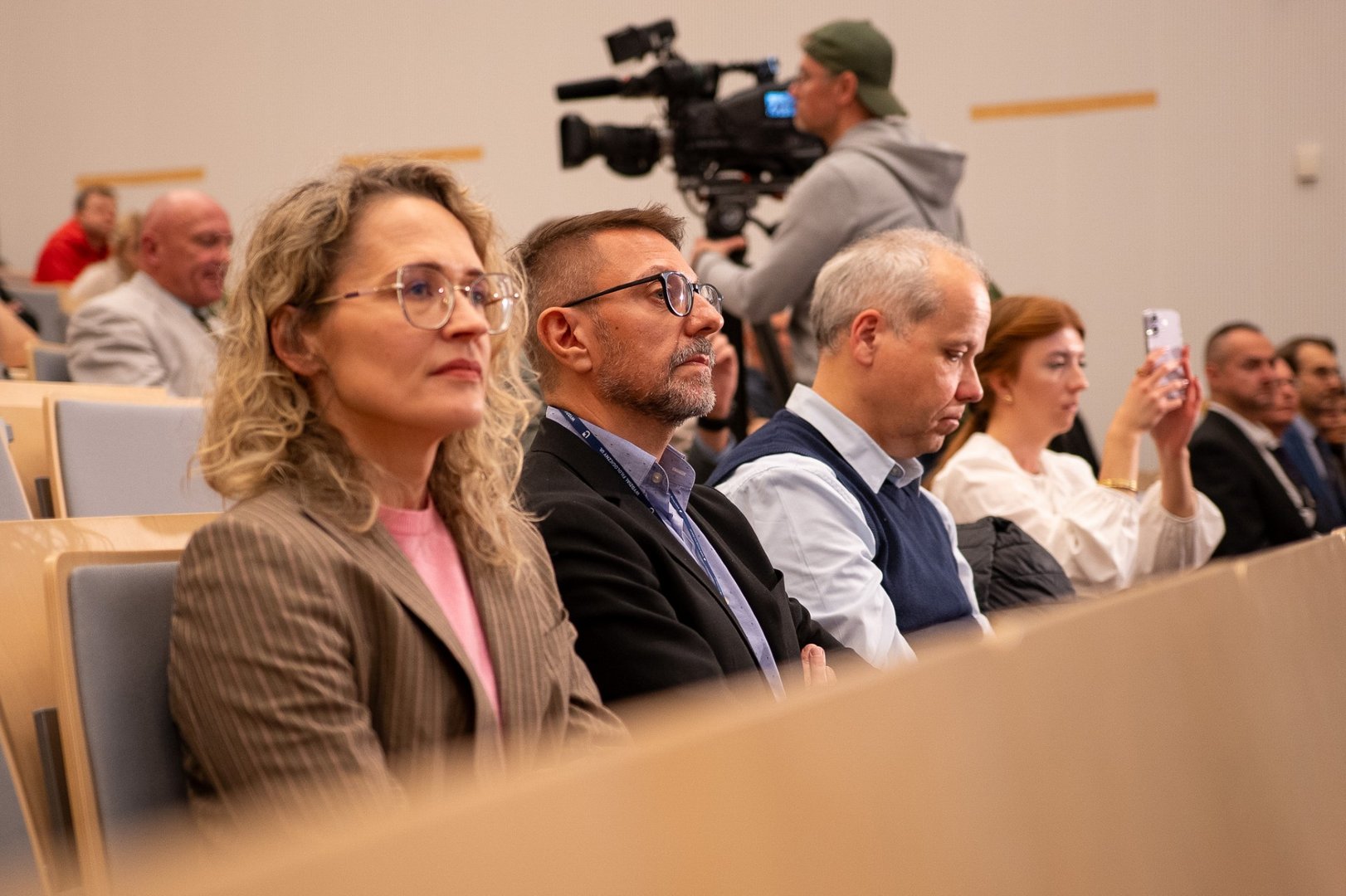
Among those gathered in the packed lecture hall there were also young people from Belarus who asked whether they could sit in places where they would not be photographed. They were afraid. This demonstrates in a very tangible way that discussions about freedom, democracy and human rights are not academic abstractions.
During the introduction of our guest, it was said that Andrzej Poczobut, through his attitude, represents what our university has in its motto: Veritas et Libertas – Truth and Freedom. It is difficult to imagine a better context for this conversation. I will briefly repeat the first question that was asked, namely: how can we explain to young people in Europe, in Poland, why freedom is such an important value? Indeed, how can this be explained to people born into a free world?
– wrote Anna Rolczak, Deputy Chancellor of the University of Lodz, on her Facebook profile after the meeting.
Full photo gallery from the meeting
Source: Dr Barbara Jundo-Kaliszewska (Faculty of International and Political Studies, University of Lodz), Press Office (University of Lodz )
Edit: Press Office, University of Lodz
Photos: Bartosz Burski, Eryk Woźniak, Maciej Andrzejewski (Centre for Brand Communications and Faculty of Philology, University of Lodz)


