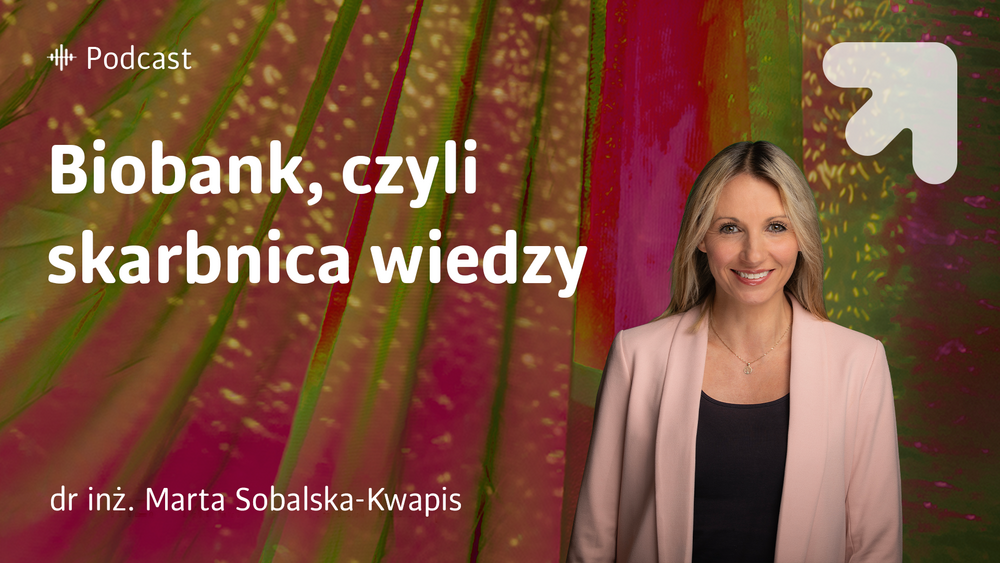
Krzysztof Tubilewicz talks to Dr Marta Sobalska-Kwapis from the Centre for Digital Biology and Biomedical Sciences – Biobank Łódź about why biobanking is so important.
The podcast series "Aleja Badaczek” (Female Researchers' Alley) recorded in cooperation between the University of Lodz and Radio 357 presents female scientists who help us better understand phenomena affecting social life – this time the starting point is health and biological data.
The bank where we deposit samples
We are a bank where biological materials of human origin can be deposited – explains dr inż. Marta Sobalska-Kwapis.
Biobanking means the secure, long-term storage of samples along with their detailed descriptions: clinical, environmental and demographic data.
The University of Lodz Biobank collects not only human material but also viral samples, animal samples and environmental samples – soil and water. It serves as a repository for clinical and oncology centres, as well as a resource for researchers in numerous fields: genetics, molecular biology, medicine and epidemiology. As the researcher underlines, depositing samples is an investment in society's future. They can be used to develop more effective therapies, better understand the mechanisms of chronic diseases and analyse the relationships between genetics and the environment.
"Europe's Great-Great-Great-Grandmothers" – This is where it all began
The beginnings of sample collection at the Biobank Łódź are linked to a population-based project that collected biological material from over 10,000 Polish men and women. This allowed the creation of one of the largest genetic databases in the country:
With such a comprehensive database, we could begin to study, describe and organise it. We began to formulate hypotheses regarding the genetic diversity of our society.
Mitochondrial DNA analyses enabled us to assign donors to specific haplogroups, i.e., the European regions from which their ancestors originated. The project, known as "Europe's Ancestral Great-Great-Great-Grandmothers" demonstrated how deeply rooted contemporary populations are in the past – and how much can be gleaned from a single sample.
Genes aren't everything
Research conducted on collected samples allows us to estimate the risk of developing specific diseases in the future. Epigenome analysis allows us to observe changes that may indicate a predisposition to lifestyle diseases.
It is no coincidence that The Times magazine has recognised the idea of biobanking as one of the leading concepts of the 21st century. It is a tool that has the potential to truly transform the way we think about public health.
At the same time, as the researcher points out, genetics alone don't provide 100% answers:
We must consider environmental factors: sleep, diet, physical activity, stress and stimulants. Genes create potential, but the environment largely determines whether and how it manifests.
Biobanks thus become a tool for studying not only individual cases but entire populations. Epidemiological studies can analyse the impact of local environmental factors on the health of residents of a given region. Sometimes, simple methods of mapping the spread of a disease are sufficient to identify its source.
The more data, the clearer the picture
Why isn't data from other countries enough? Because, as dr inż. Sobalska-Kwapis explains, each population has its own genetic makeup.
The more samples from a given group, the more accurate the image. Population studies can be compared to high-resolution photography: each person is like a single pixel, contributing its own variable to the overall image. Only from thousands of such "pixels" can a complete, reliable map of health risk be created.
Estonian example of courage
Estonia is one of the most frequently cited examples of effective biobanking coordination . In this small country, over 20 percent of the population is already covered by a biobanking programme. Importantly, a relevant law regulating the processing of medical data was established there in 2000.
Individuals who provide a DNA sample receive access to sequencing results and a diagnostic testing package. They gain insight into their health profile and, if their risk increases, can consciously modify their lifestyle.
This model demonstrates that biobanking can be a real preventative healthcare tool, not just a research tool.
Needed synergy
According to dr inż. Marta Sobalska-Kwapis, in order to fully utilise the potential of biobanks, bold systemic decisions, stable financing and cooperation between communities: scientists, physicians and state institutions are needed.
A biobank is more than just freezers with samples. It's a knowledge infrastructure that, if properly developed, can translate into better diagnostics, more effective treatment and more informed health prevention for entire populations.
Dr inż. Marta Sobalska-Kwapis works as an Assistant Professor at the Centre for Digital Biology and Biomedical Sciences – Biobank Łódź, Faculty of Biology and Environmental Protection, University of Lodz.
You can find more great content about science on the “Science Inspires” channel.
Edit: Honorata Ogieniewska, Centrum Współpracy z Otoczeniem i Społecznej Odpowiedzialności Uczelni


