
Basic Facts About the Nobel Foundation
Even though Alfred Nobel died in 1896, bureaucratic controversies surrounding his will meant that the institutionalisation of the prizes he envisioned for services to humanity took several years. As a result, the first prizes were not awarded until 1901, according to a procedure that has changed very little since then. The entire process is administered by the Nobel Foundation, an independent private institution whose main purpose is to manage and invest Alfred Nobel’s funds to ensure they do not run out. The Foundation is also responsible for organising the traditional December banquet at Stockholm City Hall celebrating each year’s laureates, as well as conferences known as Nobel Symposia. During the first half of the twentieth century, the Foundation’s presidents were primarily prominent Swedish politicians, but in recent decades the position has traditionally been held by distinguished scholars. The current president is prof. Astrid Söderbergh Widding, a specialist in film history and former Rector of Stockholm University. However, according to Nobel’s will, the Nobel Foundation plays no role in selecting the laureates. That process is conducted in two stages by different bodies for different prizes. I will describe it in detail for the Nobel Prize in Physiology or Medicine and then point out the differences that apply to the other prizes.
Awarding the Nobel Prize in Physiology or Medicine
The Nobel Prize in Physiology or Medicine is formally awarded by the Nobel Assembly at the Karolinska Institute, a prestigious Swedish medical university founded in 1810. Initially, the Assembly simply comprised all professors from the Institute. However, as the institution expanded, and particularly as the average age of professors in biomedical sciences decreased during the second half of the twentieth century, it was decided that such a distinction should be reserved for a select group. Membership of the Assembly was limited to the 50 most distinguished professors in 1984. Since then, whenever one of them retires or leaves the Institute, the remaining members vote on which member of staff should be elected to replace them. However, fifty people are still too many to deal with the practical aspects of selecting laureates, so this task is assigned to a smaller body: the five-member Nobel Committee for Physiology or Medicine. Its members are chosen from among the Assembly’s members for three-year terms and may serve a maximum of two terms. The current chair is the neurologist Prof. Per Sveningsson.
The Committee Is Already Working on the 2027 Prizes
In September of the preceding year (for example, right now in preparation for the 2027 prizes), the Committee sends nomination forms to several thousand people: all living Nobel laureates in Physiology or Medicine and Chemistry (a tacit acknowledgement that many Chemistry prizes nowadays go to biologists), members of the Assembly, all professors of medical sciences at universities in the Nordic countries (Sweden, Norway, Denmark, Finland and Iceland), and professors from selected universities around the world. These institutions are changed annually to ensure representativeness, particularly geographical diversity. It should be noted that entire universities are selected rather than individual scholars on the basis of their achievements. The Committee may also invite individual scientists to improve representativeness, although it is said to do so only rarely nowadays. It also should be noted that the details and documentation of the entire procedure are archived and remain confidential for fifty years, meaning that at present we can access little more than the lists of nominators and nominees from the 1970s. Nominators submit their recommendations electronically by midnight on 31 January. The list of nominees is then compiled and formally verified, including the removal of deceased candidates. After that, the five Committee members select ten additional temporary members from the remaining Assembly members for that year only. These individuals are chosen because they are specialists in disciplines particularly well represented among the nominations received. In the spring, these fifteen members prepare a shortlist not of candidates themselves, but of discoveries or inventions associated with them. Nobel explicitly stated in his will that prizes could be awarded not only for scientific discoveries but also for technological inventions. The shortlist is then distributed to external experts. These experts, together with the members of the expanded Committee, prepare highly detailed evaluation reports. Their most important practical task is determining which specific individuals involved in a discovery or invention deserve recognition, as the prize can be divided among no more than three people, either for the same achievement or for two or three separate achievements. This “rule of three” is controversial because it regularly results in important contributors to the research process being overlooked. The rule was introduced not by Nobel himself but by the Foundation, which sought to preserve the prestige of the prize by preventing it from being divided among too many recipients. In theory, the Foundation could abolish this rule at any time.
The Crucial Stage
The evaluation reports reach the Committee in August, and this is when the most important phase begins: discussions concerning the final selection of the achievements and individuals to be recognised. The Committee then prepares a final report containing a clear recommendation and submits it to the Assembly at the end of September. The Assembly meets in Wallenberg Hall at the Karolinska Institute’s main campus in Solna, near Stockholm, on the Monday morning of the second week of October and conducts a vote. Although this vote is usually a formality that confirms the Committee’s recommendation, the Assembly formally has the right to select different laureates. This happened, for example, in 1961, when the Committee recommended the neurophysiologists Eccles, Hodgkin and Huxley, but the Assembly, persuaded by an impassioned speech delivered by another neurophysiologist, Ragnar Granit, declined to award them the prize. They ultimately received it in 1963. The Assembly may even nominate entirely new candidates and select them, although this has never happened. Immediately after the vote, the secretary of the Assembly first telephones the laureates and then publicly announces the results. The procedure for the remaining scientific prizes is very similar, although different bodies oversee it. These prizes are awarded by the Royal Swedish Academy of Sciences, which conducts a plenary vote. However, the selection of Committee members and the preliminary approval of recommendations are handled by the Academy’s relevant “classes” (thematic sections), which means there is one additional vote involved. Furthermore, the Academy includes members not only from Sweden but from around the world, meaning that the group awarding these prizes is somewhat more cosmopolitan than the Assembly at the Karolinska Institute.
It Is Not Easy to Predict Who Will Become a Laureate…
Because of the fifty-year confidentiality rule and the slightly mystical aura surrounding the nomination and selection process, predicting Nobel laureates before their announcement is far from simple. The difficulty stems not only from the abundance of groundbreaking discoveries in the natural sciences in recent years (perhaps slightly less so in economics), but also from factors such as the length of time that has passed since key publications appeared. Committees worry that very recent achievements may not withstand the test of time, as has happened repeatedly in the past. On the other hand, they do not wish to wait too long and risk losing the opportunity to honour an outstanding scholar because of mortality. The aforementioned rule of three presents another challenge. According to anecdotal and unconfirmed reports, committees occasionally avoid recognising a discovery altogether if it proves particularly difficult to identify a non-controversial group of no more than three recipients. Finally, there is the need to remain faithful to Nobel’s wishes by recognising not only scientific discoveries but also significant technological advances from time to time. Nevertheless, the social prestige and cultural significance of the Nobel Prizes are so great that an entire prediction ecosystem has developed around them, involving scientists, journalists and even members of the public. An important predictive indicator is often considered to be the so-called precursor prizes, highly prestigious scientific awards presented at the national level, such as Israel’s Wolf Prize, the United States’ Lasker Awards, Canada’s Gairdner Awards and Norway’s Kavli Prize. An exceptionally large number of Nobel laureates previously received one or more of these distinctions, which is why predictions often focus on their recipients. Since the importance of a scientific achievement is frequently measured by citation counts, the leading organisation responsible for citation analysis, formerly Thomson Reuters and now known as Clarivate, has published annual lists of “Citation Laureates” in Nobel-related disciplines since 1989. In the vast majority of years, it has successfully identified at least one future Nobel laureate. Of course, it should be remembered that Nobel Prizes are not awarded for the scientific prestige of a discovery, or particularly an invention, but for its benefit to humanity. Nevertheless, since the decision-makers are scientists, a certain degree of bias in favour of scientific significance is perhaps unavoidable.
… But Nobody Says You Cannot Try
Predictions based on collective knowledge and disciplinary consensus are probably more reliable than those based solely on numerical indicators. Several organisations operating at the intersection of science and journalism organise annual polls on the most likely Nobel laureates in the scientific categories. The best known is the poll run by the American magazine The Scientist, which has enjoyed particularly high success rates in predicting winners of the Physiology or Medicine prize. Similar initiatives are organised by others, including the well-known publisher Multidisciplinary Digital Publishing Institute (MDPI). These competitions are often open not only to scientists but also to members of the public. An old saying suggests that the best predictions follow real money, which is why the gambling industry often produces the most reliable forecasts. Traditionally, this meant bookmakers, the same businesses that take sports bets, setting odds according to their expert judgement. In recent years, however, so-called prediction markets such as Polymarket and Kalshi have entered the picture, allowing participants to invest money in financial shares linked to future events. I encourage readers to take a look at what is currently happening on these markets in relation to the Nobel Prizes and compare today’s odds with next week’s results.
Will GLP-1 Gene “Win” This Year?
For example, on both leading prediction platforms in the field of Physiology or Medicine, Prof. Daniel Drucker, a co-author of discoveries related to the GLP-1 receptor, is currently leading by a considerable margin. Approximately forty years have now passed since the discovery of GLP-1, around twenty years since the first GLP-1 receptor drug (exenatide) entered the market, and roughly ten years since the launch of semaglutide (Ozempic), arguably the most socially and culturally influential medicine in this category. This therefore seems an appropriate moment to honour a chain of discoveries and inventions that aligns remarkably well with Alfred Nobel’s vision of rewarding those achievements that bring “the greatest benefit to humanity”. It is a fascinating story involving such unexpected protagonists as anglerfish and the Gila monster. Perhaps we shall tell that story in these pages if, on Monday, the Assembly decides that it deserves recognition this year.
Source: dr hab. Łukasz Pułaski, Associate Professor at the University of Lodz (Department of Oncobiology and Epigenetics, Institute of Biophysics, Faculty of Biology and Environmental Protection)
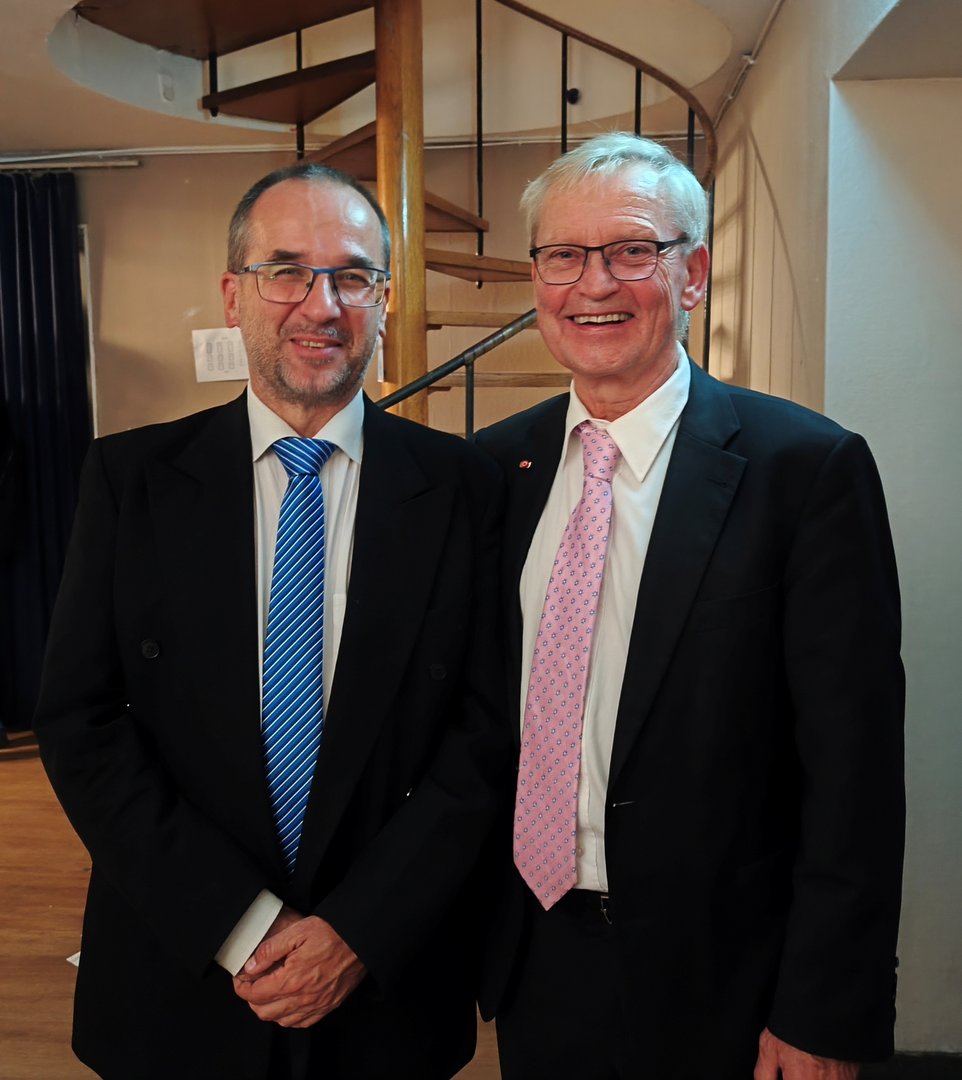
Photo: The author of the article with Prof. Carl-Henrik Heldin, President of the Nobel Foundation from 2013 to 2023; photo by Paraskevi Heldin.


