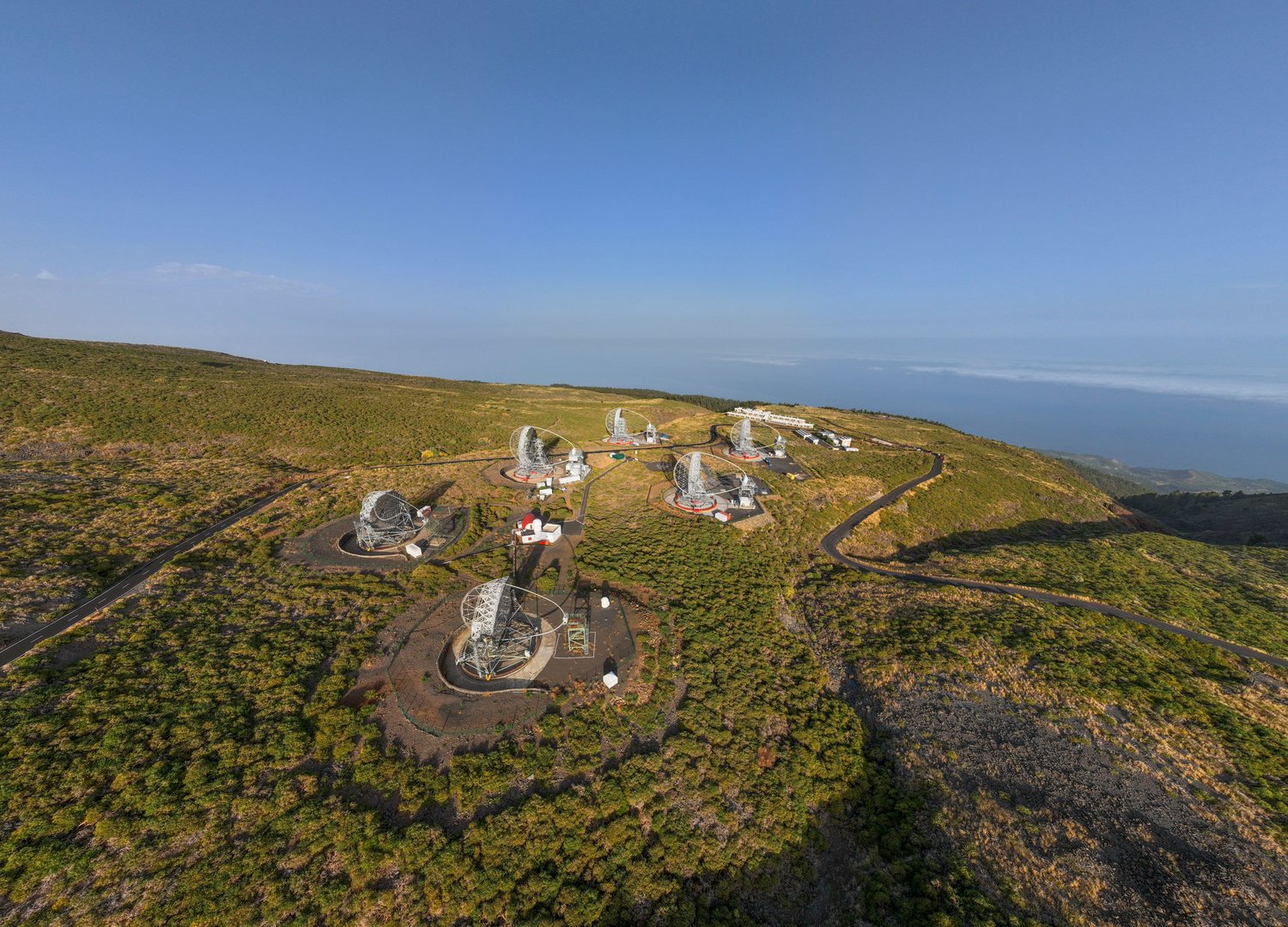
Each telescope is equipped with a 23-metre-diameter mirror and state-of-the-art ultra-fast cameras. Designed to detect faint flashes of Cherenkov radiation produced when very-high-energy gamma rays interact with the Earth's atmosphere, the LSTs will be the most sensitive instruments in the world for observing gamma rays in the energy range from approximately 20 gigaelectronvolts (GeV) to several teraelectronvolts (TeV).
This exceptional sensitivity is crucial for detecting distant and transient gamma-ray sources. As very-high-energy gamma radiation is increasingly absorbed during its journey through the Universe, the low-energy threshold of the LSTs enables scientists to study sources at cosmological distances, look further back into the history of the cosmos, and observe rapid changes in dynamically evolving gamma-ray sources with greater precision.
Pioneer: LST-1
Since 2020, already during its commissioning phase, the LST prototype (LST-1) has been delivering important scientific results. These include observations of pulsars, studies of active galactic nuclei at cosmological distances, as well as the rapid follow-up of transient phenomena such as novae and gamma-ray bursts.
With the addition of LST-2, LST-3 and LST-4 to the existing LST-1, they will form an array of four telescopes. By simultaneously observing the same particle showers generated by gamma rays from multiple viewpoints, this configuration will provide significantly improved sensitivity, angular resolution and energy reconstruction accuracy, opening a new chapter in studies of the Universe through the highest-energy gamma radiation.
Reaching Towards the Early Universe
The LSTs constitute the primary instrument of CTAO-North in the low-energy range of several tens of GeV and will provide a unique opportunity to study the Universe approximately 12 billion years ago, when it was around two billion years old. The high sensitivity of the LSTs in this energy range will enable the detection and study of bright gamma-ray bursts originating in the early Universe.
In the coming years, the LSTs will be commissioned and integrated into regular CTAO observations. Together with the other CTAO telescopes planned for both CTAO sites, they will be used to investigate fundamental questions in astrophysics, particle physics and cosmology, including the nature of dark matter, the origin of cosmic rays and the mechanisms driving the most extreme particle accelerators in the Universe.
The LST Collaboration
The LST Collaboration is an international consortium of scientists, engineers and institutions dedicated to the design, construction and commissioning of the LST telescopes for CTAO. Through this collaboration, advanced technologies in optics, photodetection, mechanical engineering and high-speed electronics have been developed.
The project has been made possible through a strong international partnership involving institutions from Brazil, Bulgaria, Croatia, the Czech Republic, France, Germany, Italy, Japan, Poland, Spain and Switzerland. The University of Lodz is the only Polish scientific institution participating in the LST Collaboration. The UniLodz group has worked, among other things, on the calibration and data-cleaning algorithms used in LST-1, which will also be employed in the remaining LST telescopes. The LST telescope array will use the ACADA control software, the development of which involved a major contribution from the team at the Nicolaus Copernicus Astronomical Centre of the Polish Academy of Sciences (CAMK).
CTAO
The Cherenkov Telescope Array Observatory (CTAO) (www.ctao.org) will be the largest and most powerful gamma-ray astronomy observatory in the world. Its unprecedented precision and wide energy range (from 20 GeV to 300 TeV) will allow CTAO to address some of the most intriguing questions in astrophysics, focusing on three main research themes: understanding the origin and role of relativistic cosmic particles; investigating extreme environments such as black holes and neutron stars; and exploring new frontiers in physics, including the search for dark matter and possible deviations from Einstein’s theory of relativity.
To cover this broad energy range, CTAO will employ three types of telescopes: Large-Sized Telescopes (LSTs), Medium-Sized Telescopes (MSTs) and Small-Sized Telescopes (SSTs). In total, more than 60 telescopes will be deployed across two observation sites: CTAO-North (at the Roque de los Muchachos Observatory on La Palma, Spain) and CTAO-South (at the Paranal Observatory in the Atacama Desert, Chile).
CTAO will generate hundreds of petabytes (PB) of data annually. In accordance with the principles of open science, CTAO will be the first very-high-energy gamma-ray observatory to operate under an open-access model, in which observing time will be awarded based on submitted research proposals, while pre-processed scientific data and software will be made publicly available.
Responsibility for the construction and operation of the Observatory, as well as the management of its sites, lies with the CTAO central organisation, formally operating as CTAO European Research Infrastructure Consortium (CTAO ERIC). Its members include Austria, Croatia, the Czech Republic, the European Southern Observatory (ESO), France, Germany, Italy, Poland, Slovenia, Spain and Switzerland. The Netherlands also holds observer status in CTAO ERIC. Australia, Brazil, Japan, South Africa and the United States are participating in the process of establishing cooperation with CTAO ERIC as strategic partners or third parties. This group works closely with partners around the world, including in-kind contributing institutions responsible for developing and delivering the necessary hardware and software, as well as the CTAO Consortium, which brings together scientists engaged in the scientific exploitation of the Observatory.
Contacts
LST Collaboration:
Prof. Masahiro Teshima
LST Principal Investigator (PI)mteshima@icrr.u-tokyo.ac.jp
LST Outreach Group lst-outreach@cta-observatory.org
Polish LST Group
Prof. dr hab. Julian Sitarek jsitarek@uni.lodz.pl (Uniwersytet Łódzki)
CTAO (Cherenkov Telescope Array Observatory):
CTAO Communications Office
Dr Alba Fernández-Barral
CTAO Chief Communications Officer alba.fernandezbarral@cta-observatory.org
Chair of the Polish CTAO Group:
Prof. dr hab. Jacek Niemiec jacek.niemiec@ifj.edu.pl (The Henryk Niewodniczański Institute of Nuclear Physics Polish Academy of Sciences)
Source and edit: Prof. dr hab. Julian Sitarek


