
A Distant Galaxy Across Time and Space
Very-high-energy gamma radiation consists of photons, elementary particles of light, whose energies are hundreds of billions of times greater than those of visible-light photons. At such energies, gamma rays travelling through the Universe can interact with low-energy background light, producing matter in the form of electron-positron pairs. Detecting these extremely energetic photons requires specialised observational techniques that combine astronomy and particle physics. The MAGIC telescopes, each with a mirror diameter of 17 metres, and LST-1, with its 23-metre mirror, belong to a class of instruments known as Cherenkov telescopes. They are capable of detecting gamma rays with energies ranging from several billion to hundreds of trillions of times greater than those of visible light. Joint observations of the active galaxy OP 313 resulted in the detection of radiation that had travelled for approximately 8 billion years before reaching Earth. This established a new distance record for a source observed in the very-high-energy gamma-ray range. With a redshift of 0.997, OP 313 became the most distant blazar ever detected at these energies. During its journey across the Universe, the radiation interacted with the Extragalactic Background Light (EBL), the diffuse light produced by all galaxies and cosmic dust accumulated throughout cosmic history. These interactions mean that only a small fraction of the original gamma-ray photons survive the journey to Earth. Observing and studying this emission was possible only thanks to the exceptional sensitivity of the MAGIC and LST-1 instruments.
The Discovery
Active galaxies are galaxies whose central regions produce highly variable radiation far exceeding the thermal emission generated by their stars. They are believed to be powered by matter falling onto supermassive black holes. Some active galaxies launch powerful jets of matter travelling at speeds close to that of light. In the case of OP 313, one of these jets is directed towards Earth. OP 313 belongs to a class of objects known as Flat Spectrum Radio Quasars (FSRQs), among the most energetic types of active galactic nuclei. In December 2023, LST-1, the first Large-Sized Telescope of the future Cherenkov Telescope Array Observatory (CTAO), detected very-high-energy gamma-ray emission from OP 313 during an exceptionally bright flare. This marked the first detection of VHE gamma rays from the source and made OP 313 the most distant blazar ever observed at these energies. The results of this research, conducted with the participation of the MAGIC telescopes, have now been published in Astronomy and Astrophysics (PDF Version).
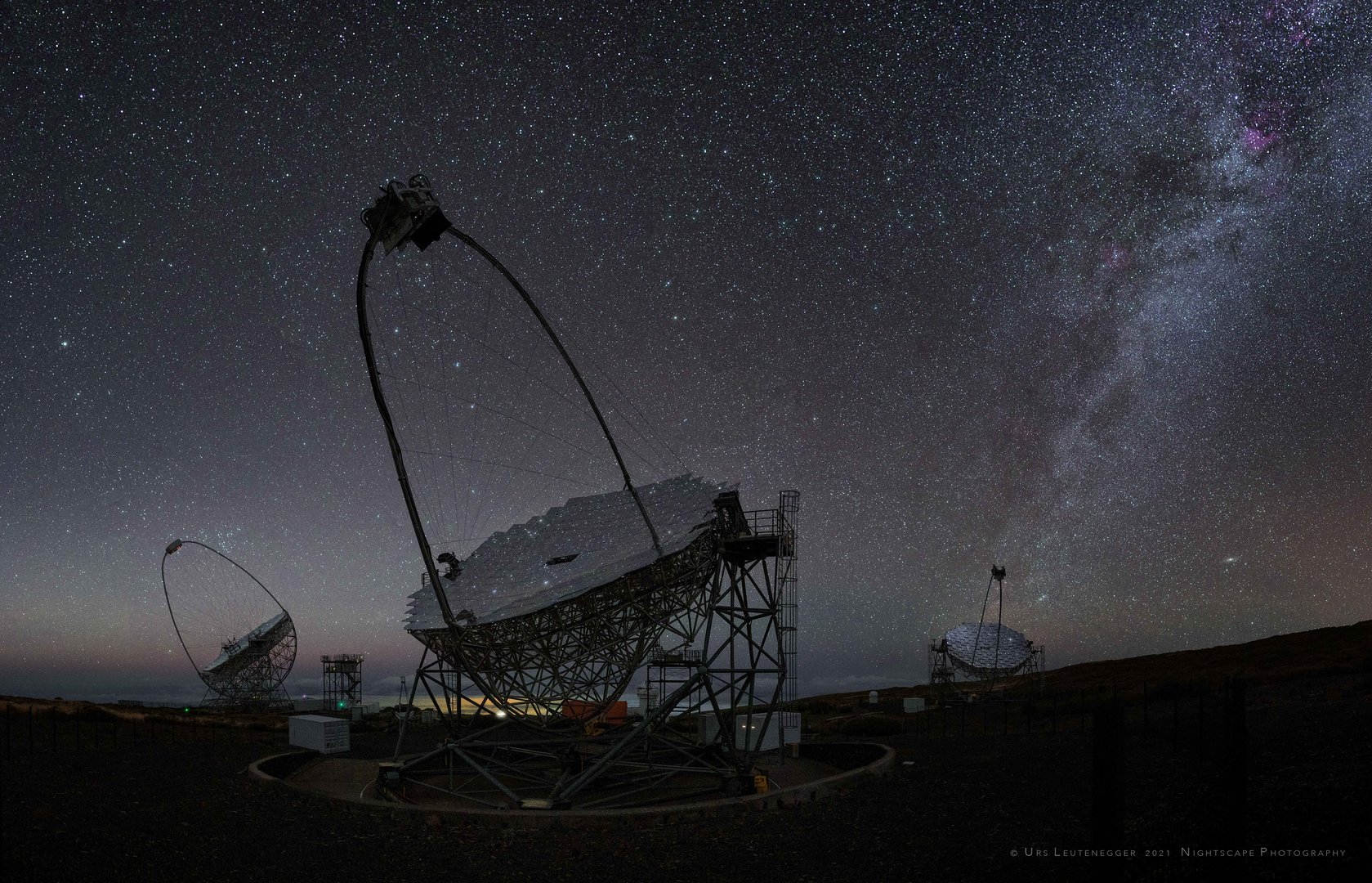
Scientists from the MAGIC and CTAO/LST collaborations analysed data from both instruments, placing strong constraints on the density of the Extragalactic Background Light. Combined with broad multiwavelength observations at lower energies, they were able to characterise the variability of the source. The study indicates the acceleration of high-energy electrons within the jet of OP 313 and contributes to a better understanding of the physical processes taking place in this type of object. The findings also demonstrate the effectiveness of joint observations conducted with Cherenkov telescopes, particularly the new-generation LST-1 telescope. In the near future, LST-1 will be joined by three additional Large-Sized Telescopes at the Roque de los Muchachos Observatory, followed later by five 12-metre Medium-Sized Telescopes (MSTs). The northern CTAO array, consisting of four LSTs and five MSTs, will significantly improve the sensitivity of very-high-energy gamma-ray observations and extend the observational horizon to distances that have so far remained beyond the reach of instruments of this class.
MAGIC, LST-1 and CTAO
MAGIC is a system of two Cherenkov telescopes located at the Roque de los Muchachos Observatory. The first telescope began observations in 2003, while the second was completed in 2009. The MAGIC telescopes revolutionised very-high-energy gamma-ray astrophysics by opening up an energy range that was too high for satellite-based instruments and too low for previous generations of Cherenkov telescopes. To date, the MAGIC Collaboration has published more than 200 papers in peer-reviewed scientific journals, fundamentally transforming our understanding of the extreme Universe through a series of groundbreaking discoveries.
LST-1 is the first Large-Sized Telescope of the Cherenkov Telescope Array Observatory (CTAO), which is currently being developed on the Canary Island of La Palma in Spain and on the Paranal Plateau in Chile. Large-Sized Telescopes are the largest class of instruments within the CTAO. Their design has been optimised to detect, with high sensitivity and rapid response times, radiation in the energy range between that accessible to detectors in Earth orbit and that observable from the ground. With a 23-metre diameter and the ability to rapidly reposition towards any location in the sky, these telescopes provide a powerful tool for investigating extreme phenomena in the Universe. LST-1 was completed in 2018 at the Roque de los Muchachos Observatory and will soon be joined by three additional LSTs already installed at the site. The inauguration of the four-LST array, planned for 15 October 2026, will mark an important milestone in the history of very-high-energy gamma-ray astrophysics and in the implementation of the CTAO project.
Source: Press release of the Polish LST Group (University of Lodz), Prof. dr hab. Julian Sitarek
Edit: Michał Gruda (Centre for External Relations, University of Lodz)


