Artificial Intelligence: A Civilisational Breakthrough or a Cause for Concern?
The starting point for exploring the topic of AI was the observation that, in an extraordinarily short period of time, it has permeated almost every aspect of everyday life. AI suggests content on social media, helps us write texts, translates languages, creates images and is increasingly becoming involved in educational processes. With astonishing speed, it has become one of the most ubiquitous tools in the modern world. Moreover, a technology that was initially intended merely to support humans is increasingly taking over tasks previously carried out independently. According to the authors, this raises questions not only about the future of the labour market, but also about interpersonal relationships and our ability to think independently.
I think all of us have noticed how artificial intelligence has begun to appear in every aspect of our lives. At first, these were small things that did not seem particularly significant, but over time it kept growing. Nowadays, it is difficult to find something that does not use artificial intelligence. Social media, search engines, video games, even music and films. AI has transformed from something intended to make our lives easier into something that completely replaces human beings, and that is frightening in a way. Even at our university, during classes, suggestions are made to use artificial intelligence in certain aspects. I feel that, in addition to intellectual value, AI is beginning to ‘steal’ the human soul. People are becoming increasingly dependent on it, losing the ability to think independently and build relationships with others because the computer does everything for them. It can be their friend, girlfriend or boyfriend, therapist... And they do not have to make an effort because the computer will always agree with them and take their side
– emphasises Michalina Kędzierska.
The authors point out that the public debate surrounding generative artificial intelligence often focuses on its benefits while overlooking its social and environmental costs. In their article, they wanted to draw attention to the less obvious consequences of the development of this technology, ranging from the consumption of natural resources and copyright issues to its impact on people’s everyday lives.
Since the emergence of generative AI, there has been a narrative that it is a breakthrough technology, an essential tool for everyone and an inevitable stage of civilisation’s development. Nevertheless, I have always been sceptical because every form of progress comes at a price, and it is usually the environment and ordinary people who pay it. Through this article, we wanted to highlight the negative impact of this technology on the environment and society, as well as the way AI infringes copyright. One example of its environmental impact is the enormous amount of clean water used to cool data centres and the huge quantities of energy required to operate them. In addition, data centres generate substantial carbon dioxide emissions. All of this contributes to climate change and drought, effects that all of us experience during heatwaves. Around the world, it is becoming increasingly common for people to lose their jobs because they are being replaced by AI, for example graphic designers and voice-over artists. Interestingly, AI requires a sufficient amount of information in order to generate content, and current models were trained, among other things, on data created by online content creators and artists who shared their work on the internet, often without their consent
– notes Natalia Machnik.
AI is used in every aspect of our lives, even in areas that do not necessarily require it. People may simply fail to notice the connection between the infrastructure behind this machinery and certain everyday problems. The increasing cost of electricity and water in areas located near data centres is one of the examples. Another example comes from the state of Georgia, where Georgia Power, with the support of the local government, forced one family to sell their home in order to expand the power grid specifically to supply nearby data centres. A more easily verifiable consequence can be seen in the prices of electronic devices. Some people may attribute these increases solely to inflation, but in reality many AI companies purchase unimaginable quantities of RAM memory. This drives up the price of numerous electronic products whose dependence on RAM may not even occur to most people. Personally, I wanted to draw attention to this connection because the more deeply one examines it, the more serious it appears
– adds Jakub Lisik.
“Wall-E: Closer to Reality Than ”Terminator": The Origin of the Article’s Title
Popular culture served as the inspiration for the publication’s title. The authors referred to two visions of artificial intelligence: the futuristic world depicted in “Wall-E” and the darker vision known from the “Terminator” series, in which the SkyNet system plays a central role.
Wall-E presents a future in which humanity has destroyed the ecosystem of its planet and, after escaping into space, has become so dependent on artificial intelligence that people have forgotten how to perform something as basic as walking. Today, we already look somewhat similar, with AI replacing fundamental human activities and, to a certain extent, harming our ecosystem.
SkyNet represents the opposite scenario, where AI, instead of serving as the perfect assistant, rebels and attempts to destroy humanity. SkyNet is often mentioned in discussions about AI, but in our article we wanted to provide a more objective vision of AI’s influence on our lives. There are certainly some parallels with reality, and AI systems for military applications are already being developed, but they are nowhere near as advanced as those portrayed in the Terminator films – adds Jakub Lisik.
– adds Jakub Lisik.
According to the authors, it is the vision presented in “Wall-E” that appears more relevant today than the scenario of a machine uprising. The issue is not robots taking over the world, but rather the gradual transfer of successive areas of human activity to technology. The title was intended not only to attract attention but also to encourage readers to reflect on the direction in which the modern world is heading.
Academic Discussion as the Inspiration for Entering the Competition
The whole story began during classes devoted to the use of AI in scientific work. The students presented their critical perspective on the topic and differing opinions gave rise to an academic discussion that proved highly inspiring.
We had classes where methods and principles for using artificial intelligence in scientific work were presented. The Professor leading the course was quite surprised by the entire group’s negative attitude towards the topic, and the classes gradually turned into a discussion group
– explains Jakub Lisik
Everyone in the group had an individual interest in how AI actually functions and during the classes we shared our opinions
– adds Natalia Machnik.
The Professor conducting the tutorial recognised the value of the discussion and encouraged the students to present their reflections in the form of a competition article.
After the classes ended, we received an email with a link to the competition and a suggestion that anyone interested could write an article on the topic. The four of us decided to do it. We considered it something important. It is an issue that we take very seriously
– adds Michalina Kędzierska
The competition became an opportunity not only to present their own views but also to encourage others to take a critical look at the development of new technologies.
A Recipe for Success: Teamwork or a Sum of Individual Efforts?
Although each author was responsible for a different section of the article, the work was collaborative in nature. Everything began with a joint meeting during which an outline and plan of the key issues were developed. Team members then divided the topics according to their interests and expertise. The result was a text that was cohesive both substantively and stylistically.
At the beginning, we had a meeting where we planned everything. We discussed the topic, outlined what we wanted to communicate and only then moved on to more detailed work. We divided specific topics among team members according to individual interests and strengths. While writing, we shared links, posts and suggestions with one another. Afterwards, everyone read the other sections and we began combining them into a single text. Throughout the process, we were very much on the same wavelength and agreed on what mattered most to us
– explains Michalina Kędzierska.
Everyone was responsible for their own part, but there was no shortage of helpful opinions and suggestions
– recalls Natalia Machnik.
I was particularly interested in copyright issues, so my colleagues agreed that I should focus on that aspect
– adds Michalina Siudowska.
The Value of Speaking Up
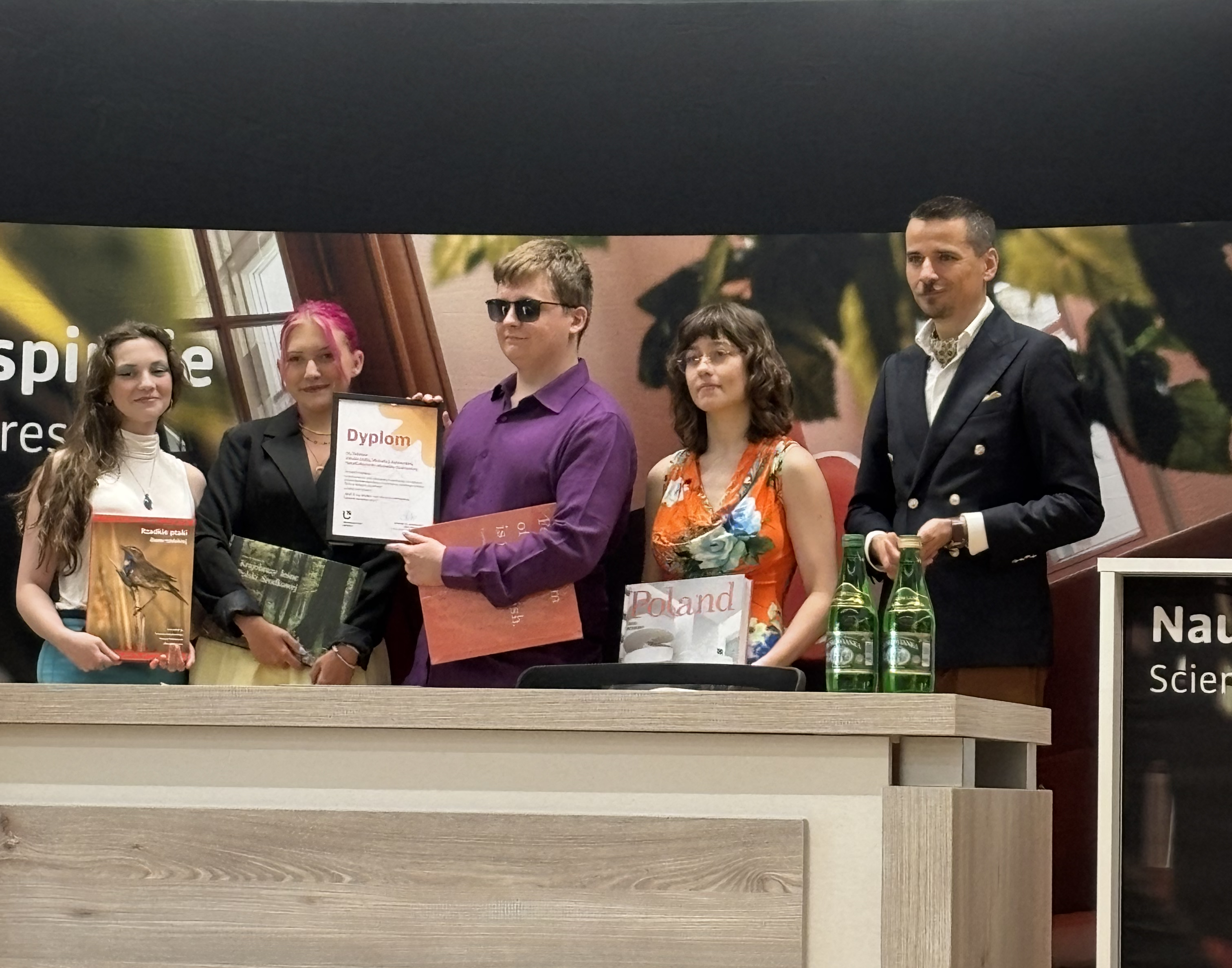
The Prof. Mirosław Przybylski Competition for the Best Popular Science Article, as part of which the article was created, was held for the second time. Its aim is to demonstrate that science can be written about in an inspiring and engaging way, making academic content understandable and accessible to a broad audience. Another objective is to spark public interest in the world of science. This, in turn, contributes to a better understanding of the reality around us and broadens horizons.
For participants, taking part in the competition is not only an opportunity to win a financial prize but also a chance to share their knowledge and feel that their voice matters. Moreover, the article will be published by the University of Lodz in an anthology of competition entries. As the laureates emphasise, however, the distinction itself was above all a tremendous source of satisfaction.
I am proud of myself. I enjoy sharing information and writing publications. I feel that my passion has been recognised
– Michalina Siudowska shares her joy.
I am happy not only because of the award, but also because someone may become interested in the topic and perhaps explore it further
– adds Jakub Lisik.
I was truly delighted. It is always encouraging when the time and effort you have devoted to something are appreciated
– emphasises Natalia Machnik.
It is a very pleasant feeling to have your work recognised, especially when it concerns something that is important to you
– recalls Michalina Kędzierska
Scientific Knowledge Not Only for Experts: The Value of Science Communication
The authors are unanimous: science cannot remain confined solely to specialist articles and academic language. In a world saturated with information, it is becoming increasingly difficult to distinguish reliable knowledge from opinions or fake news. This is why the ability to explain complex issues in a simple and understandable manner is becoming ever more important.
Today we are witnessing a very strong anti-intellectual movement, and social media certainly do not help. Presenting science in an accessible way is therefore extremely important. In my opinion, people should want to know more and should have greater opportunities to learn
– stresses Michalina Kędzierska.
The students point out that science communication is not merely about providing free access to publications. Equally important is creating content that allows people outside academia to understand key issues.
Science communication increases public awareness of topics that affect most people. It is important for science to be accessible to everyone. This is not only about free access to scientific articles, but also about enabling people to gain basic information without having to ‘decode’ scientific language. I believe that as much content as possible should be created across a variety of fields using accessible language. This allows people who are not specialists in a given area, but who want to gain basic knowledge, to expand their understanding
– underlines Natalia Machnik.
Today, we have easy access to information, but there is so much of it that it is easy to become lost. I hope that science communication can help people find their way
– concludes Jakub Lisik.
Science communication is extremely important, mainly because I consider scientific knowledge to be extraordinarily valuable and fascinating
– emphasises Michalina Siudowska.
Courage, Curiosity and Action: Advice for Future Competition Participants
The authors have a simple yet important message for all students considering taking part in similar initiatives. Above all, they emphasise willingness and courage to act.
Just do it! It does not matter if you have never done it before. It does not matter if you do not know what to do. It does not matter if you are afraid. It is worth doing things even when you are afraid. You never know what may come of it. Even if you do not succeed in this competition, it may be the drop that breaks the dam and encourages you to keep trying. Perhaps you will meet people who are interested in the same topic. It is always worth giving it a go
– encourages Michalina Kędzierska.
The authors also underline the importance of choosing a topic that genuinely sparks interest.
I would advise choosing a topic that genuinely falls within your area of interest. This is a short text, so it is worth writing it in a way that contains new information without becoming overly detailed. If you succeed in sparking interest, perhaps the reader will begin exploring the topic independently
– advises Natalia Machnik.
As the authors note, winning a competition should not be the ultimate goal. What truly matters is the new experience and the willingness to take on a challenge that broadens horizons and develops new competencies.
If you win, that is wonderful. If not, you can still be proud of yourself because it is always a valuable new experience
– adds Natalia Machnik.
They also offer advice regarding organisation and cooperation.
Divide the work, set clear deadlines and be prepared to compromise
– advises Michalina Siudowska.
This is the essence of science communication: not providing ready-made answers, but inspiring people to ask further questions.
Source: Jakub Lisik, Michalina Kędzierska, Natalia Machnik, Michalina Siudowska (Faculty of Biology and Environmental Protection, University of Lodz)
Edit and photos: Kamila Knol-Michałowska (Promotion Centre, Faculty of Biology and Environmental Protection, University of Lodz)


